The 2026 Nobel Prize in Physics has been awarded to Francis Halzen of the University of Wisconsin–Madison. The official October 6 announcement recognises his contribution to the IceCube Neutrino Observatory and the discovery of high-energy neutrinos of astrophysical origin. He is the sole recipient named for this year’s physics prize.
IceCube is unlike a conventional telescope that magnifies incoming light to make a picture. It uses a vast volume of Antarctic ice as a detection medium, reading flashes produced by rare neutrino interactions. For readers in India searching the new laureate’s name, the next useful question is why ice can help us observe the Universe.
A huge detector for particles that rarely interact
Neutrinos interact only weakly with matter. That makes them valuable messengers from distant places, but it also means a particle crossing a detector need not leave a measurable signal. The Nobel explanation traces Halzen’s Antarctic-ice concept to 1988. The observatory’s scale addresses the need to catch rare events.
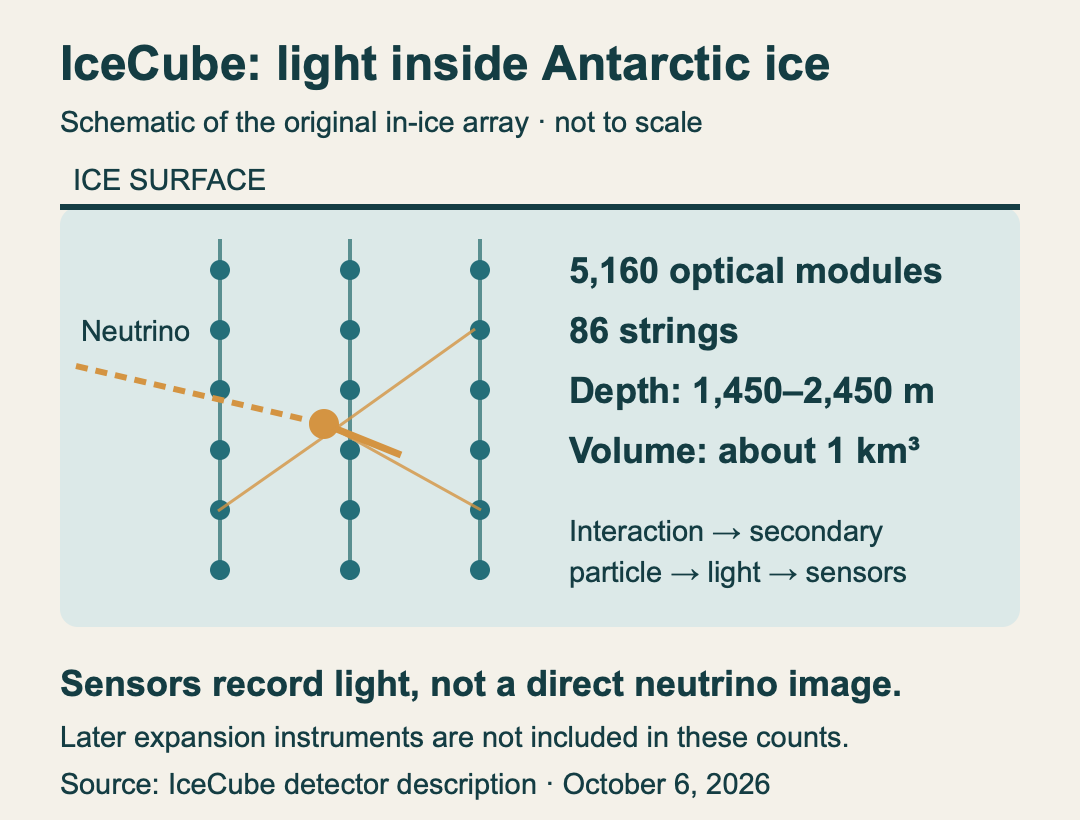
IceCube describes its original in-ice array as 5,160 optical modules on 86 strings, at depths of roughly 1,450–2,450 metres. The instrumented volume is about one cubic kilometre. These figures describe that original array; they should not be presented as a count including every later expansion instrument.
The sensors read light left by an interaction
When a neutrino interacts in the ice, it can produce a charged secondary particle. A particle moving faster than light travels through that ice emits Cherenkov light, which the sensors record along with its arrival time. This does not mean exceeding the speed of light in a vacuum.
Researchers combine signals from multiple sensors to infer direction and energy. Neutrinos are not bent by magnetic fields as charged cosmic rays are, opening another route to information about astronomical sources. That does not imply every detected signal comes from the same object, or that every source has already been identified.
How to keep the current-affairs answer accurate
For study notes, connect three elements: the laureate and affiliation, IceCube’s role, and the discovery of high-energy cosmic neutrinos. Read the official award announcement linked below for the reason, then IceCube’s detector explanation for the method. This gives the relationship behind the headline rather than only a name to memorise.
Calling this the first discovery of the neutrino itself, or a solution identifying every cosmic-ray source, would overstate the award’s scope. A useful question for future findings is how convincingly an event can be associated with a particular astronomical object. Recording more particles and establishing where they began are connected achievements, but they are not identical.
Sources checked October 6, 2026. Confirmed reporting, unconfirmed scope and editorial interpretation are distinguished.
AI assisted with drafting and editing. This article is part of our preview edition. Editorial standards & corrections →