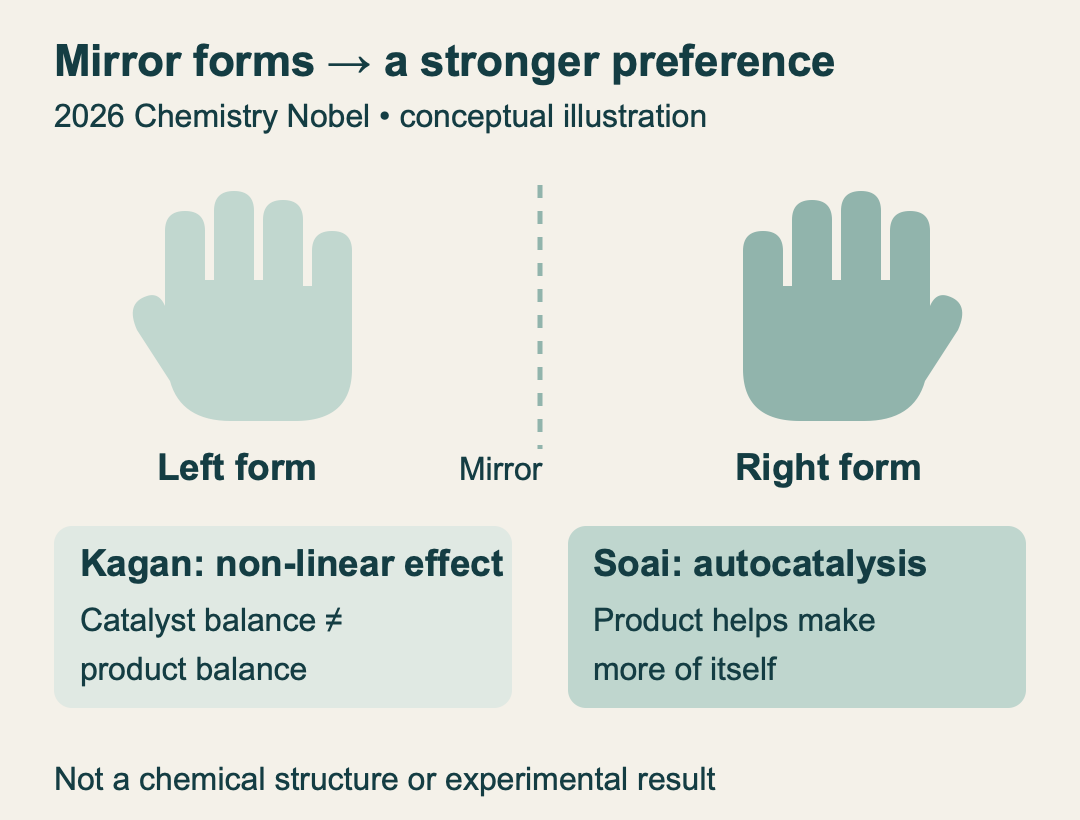
Henri B. Kagan and Kenso Soai have won the 2026 Nobel Prize in Chemistry for discoveries in asymmetric organic synthesis, the Royal Swedish Academy of Sciences announced on October 7. Kagan’s non-linear effects and Soai’s autocatalysis help explain how a reaction can strongly favour one of two mirror-image molecular forms.
Knowing the winners is only the start: the announcement concerns specific chemical mechanisms rather than a new drug. Kagan is associated with the former Université Paris-Sud in France; Soai with Tokyo University of Science in Japan. The prize is shared equally.
Why the mirror image matters
Some molecules have two forms that are mirror images but cannot be superimposed, like left and right hands. The forms are called enantiomers; chirality describes this handedness. A chemical reaction may produce both, while biological systems can respond differently to them. Producing the form needed is therefore a central problem in asymmetric synthesis.
The award addresses how a strong preference for one form can develop in a chemical reaction. It does not mean that the two scientists have discovered a new medicine on October 7, or proved the exact historical route by which life began. The Nobel background distinguishes Soai’s artificial reaction from life’s own chemistry.
Kagan’s non-linear effect and Soai’s autocatalysis are different
Kagan’s 1986 work showed that the balance of mirror-image forms in a catalyst need not pass to the product in a simple proportional way: the product can show a greater preference. “Non-linear” describes that relationship, rather than a claim that every reaction automatically gives a pure product.
Soai’s key 1995 publication described a reaction whose product helped catalyse production of more of itself. That self-reinforcing process is autocatalysis. Further work reported in 2003 showed exceptionally strong selection of one mirror form. The official background also notes that, when a tiny starting imbalance is due to chance, either form can become dominant.
Read the award as a tool for synthesis
The practical relevance is to chemists designing and studying reactions, including those used in pharmaceutical manufacturing. The scientific question is how a reaction selects and amplifies a form, and under what conditions. The two discoveries give information and methods for answering that question; they are not a universal guarantee about every compound or drug.
Start with the official prize summary for the winners and equal shares, then the press release for the award rationale, and the popular-science background for the difference between the two discoveries. The diagram below is our conceptual explanation, not a molecular structure or an experimental result.
What to remember beyond the names
The useful chain is mirror-image forms, a reaction that favours one form, and a mechanism that can amplify that preference. Keeping non-linear effects separate from self-catalysis explains why both researchers are recognised, rather than reducing the award to a memorised pair of names.
Further reports should be read for the particular reaction and the evidence behind an application. The important limit remains the same: demonstrating an artificial route to molecular asymmetry is a scientific advance, while claims about life’s exact origin or a specific new treatment need separate evidence.
Official sources were checked directly. Unannounced conditions, individual results and editorial calculations are distinguished in the article.
- NobelPrize.org: 2026 Chemistry prize summary ↗
- NobelPrize.org: October 7 press release ↗
- NobelPrize.org: Popular science background ↗