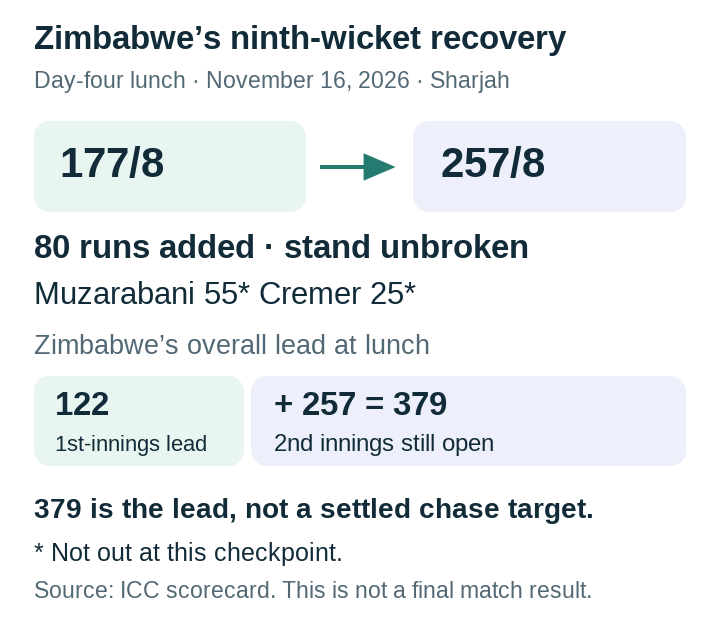
Blessing Muzarabani was 55 not out and Graeme Cremer 25 not out at lunch on day four of the Afghanistan–Zimbabwe second Test in Sharjah on November 16. Their unbroken ninth-wicket stand had reached 80, taking Zimbabwe to 257/8 in the second innings and a lead of 379. These are the lunch checkpoint figures, not a final match result.
The Test began on November 13 at Sharjah Cricket Stadium. Zimbabwe’s first-innings 339 and Afghanistan’s 217 had already created a 122-run advantage before the second innings. For readers following Muzarabani’s contribution, the new feature at this checkpoint was his batting recovery with Cremer after eight wickets had fallen.
Two unbeaten batters extended the lower order
The ICC scorecard at lunch listed Muzarabani’s 55 from 77 balls, including nine fours and one six. Cremer’s unbeaten 25 also came from 77 balls. Both were still batting when play paused, so the asterisks describe unfinished innings rather than completed personal totals.
The official fall-of-wickets list puts Tafadzwa Tsiga’s dismissal at 177/8 after 60.5 overs. With Zimbabwe 257/8 after 85 overs at lunch, the ninth-wicket pair had added 80 without another dismissal. That recovery increased the lead from 299 at the eighth wicket to 379 at the interval.
How the stand changed the position
The lower-order partnership mattered because a side already eight wickets down continued to add to its first-innings advantage. Afghanistan had moved close to ending the innings at 177/8; the next 80 runs made the gap larger without consuming another wicket. The scorecard establishes that change in position, but does not by itself prove a diagnosis about the pitch or particular bowling decisions.
The 379 figure was Zimbabwe’s lead, not a settled fourth-innings chase target. Its second innings was still open at 257/8 at the lunch checkpoint. A target depends on where that innings finishes or is declared, so a live lead should not be reported as though the innings has already closed.
Follow the same match record after lunch
Use the ICC match page linked below and its innings scorecards for subsequent wickets, any declaration and the eventual result. Select Zimbabwe’s second innings when checking the Muzarabani–Cremer stand; the first-innings batting and bowling figures answer different questions. Search summaries and social posts can retain an earlier session’s numbers after the live card moves on.
At this interval, Muzarabani’s batting had helped turn an eight-wicket situation into a substantial unbeaten lower-order recovery. The next judgment turns on how the innings ends and how Afghanistan responds. The 80-run stand explains the stronger position at lunch; it does not guarantee the outcome of a Test still in progress.
Based on the dated records and official guidance below. Confirmed facts, interpretation and limits are distinguished.
AI assisted with drafting and editing. This article is part of our preview edition. Editorial standards & corrections →