Sri Lanka finished their first innings on 446 in the first Test against Pakistan at Rawalpindi, taking a 12-run first-innings lead over Pakistan’s 434/9 declared. Dhananjaya de Silva made 167 and Kusal Mendis 119, while Saqib Khan returned 7/130. The completed innings was on the board on November 12, day four; Pakistan’s second innings had already begun, so 12 runs is not the live overall lead or the match result.
The match is scheduled for November 9–13 at Rawalpindi Cricket Stadium. Sri Lanka had ended day two on November 10 at 114/3, still 320 behind, according to the ICC’s dated report. Their completed 446 therefore marks a substantial recovery from that position. Understanding its effect also requires the wickets lost near the end, which limited how far they moved ahead of Pakistan’s declared total.
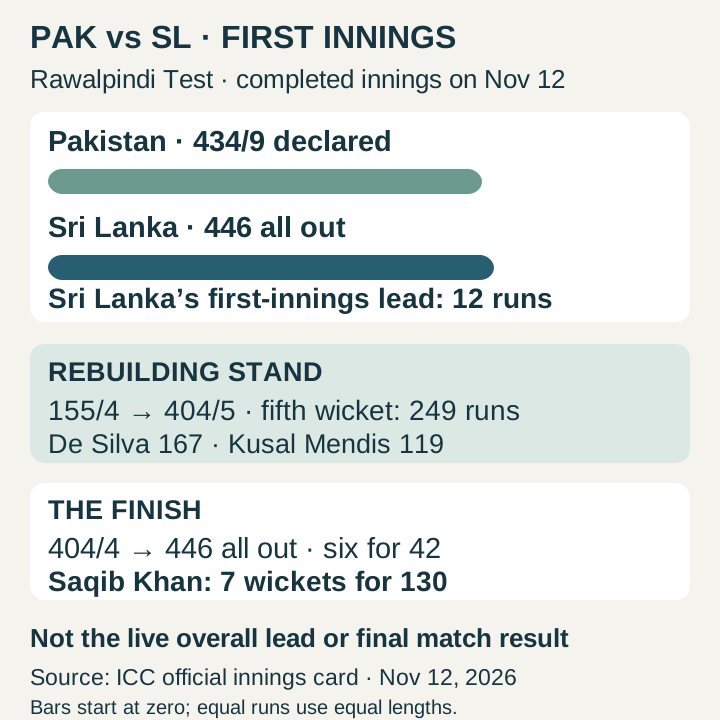
The 249-run rebuilding stand
De Silva and Kusal Mendis built the central stand. The official fall-of-wickets card moves from 155/4, when Kamindu Mendis was dismissed for 58, to 404/5 at de Silva’s dismissal. The difference is a 249-run fifth-wicket partnership. Their two centuries supplied the major rebuilding phase after the earlier deficit.
Sri Lanka were 404/4 before the fifth wicket fell and were all out at 446. That is six wickets lost for 42 runs. The sequence explains why a large partnership and two centuries produced only a narrow first-innings advantage: the tail did not extend the total far beyond the position reached by the stand.
Six for 42 and Saqib’s seven wickets
Saqib’s official figures are seven wickets for 130 from 34 overs, including five maidens. His dismissals included de Silva, Kusal Mendis, Sonal Dinusha, Lahiru Kumara and Asitha Fernando late in the innings. Mohammad Abbas finished with 2/68 and Razaullah with 1/140. The wickets connect Saqib’s seven-wicket return to the curtailed lead rather than merely adding a separate personal milestone.
The arithmetic is 446 minus 434, giving 12. That compares the completed first innings only; it is not a chase target. Pakistan’s second innings changes the overall lead as play continues, and no winner or World Test Championship points can be assigned from the first-innings comparison. This report preserves the completed-innings milestone.
First-innings margin and the continuing match
The ICC match centre below provides the current state and separate innings tabs, allowing readers to distinguish the completed Sri Lanka card from Pakistan’s continuing innings. The second Test is scheduled for November 17–21 in Rawalpindi as well, after the move from Lahore described in our linked venue guide. Those official score and schedule routes do not establish Indian broadcast rights or free live video.
Sri Lanka’s recovery and Pakistan’s late wickets both shape this stage of the match. The 249-run stand turned a large deficit into a potential advantage, while six for 42 kept that advantage to 12 at the first-innings break. What Pakistan builds in its second innings and the remaining play will determine the contest. The completed card supports that balanced reading, without predicting a final outcome.
Public original sources checked on November 12, 2026. Source dates, applicable markets and the distinction between completed facts and ongoing outcomes are retained.
- ICC official first Test scorecard, Sri Lanka first innings selected ↗
- ICC official November10 Day2 report and series dates ↗
- Cricbuzz live commentary, full visible match page ↗