Bukayo Saka won the 2026 Sócrates Award for humanitarian work at the Ballon d’Or ceremony on 26 October. The organiser recognises his work supporting vulnerable people and opposing hatred, while Arsenal points to his family’s long-running charitable partnerships, including BigShoe. This is recognition for work beyond the pitch, rather than an award for goals or match performances.
The Sócrates Award has been presented since 2022, with the organiser describing its scope as humanitarian work by a footballer over the previous year. The winner’s longer history helps explain that commitment, but an operation funded in 2022 should not be presented as a new 2026 intervention. Separating recognition from the dates of individual projects makes Saka’s contribution easier to assess.
From the award to the projects it brings into view
Arsenal describes medical support in London and other parts of the world, emergency housing after earthquakes in Turkey and Morocco, and surgeries for children in Nigeria and elsewhere in Africa. These activities address different needs: access to treatment and shelter after disaster. They also involve charities carrying out the work, so a player’s financial support and an organisation’s delivery are related but distinct contributions.
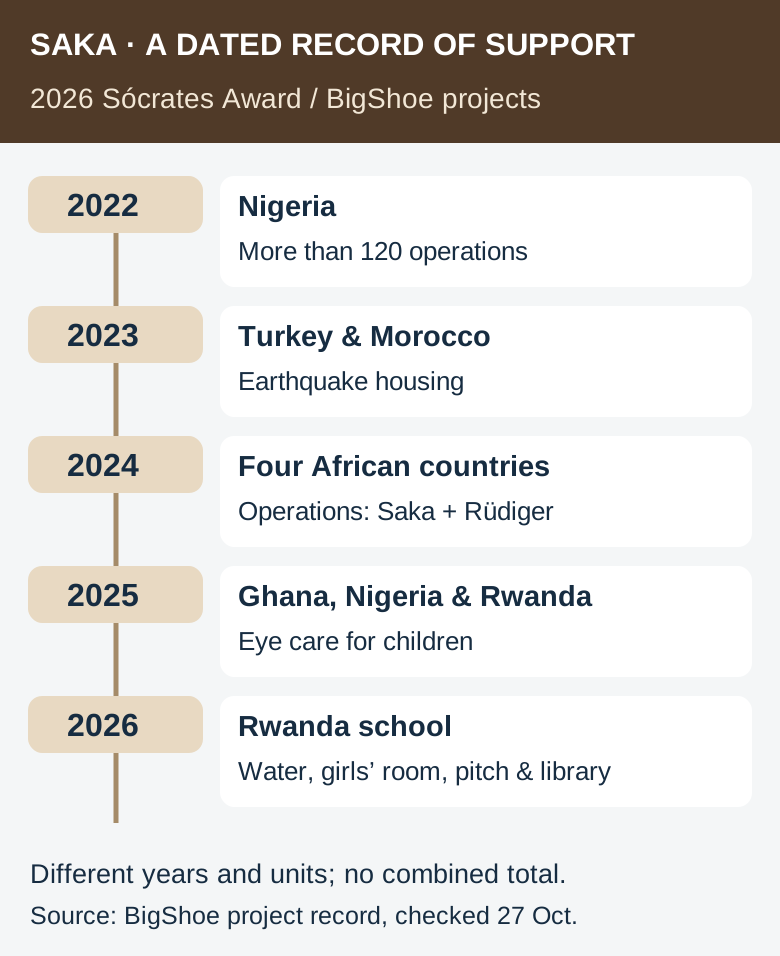
BigShoe’s project record supplies the dates. It lists Saka’s funding of more than 120 operations in Nigeria in 2022. For 2023, it records shelters for 26 families in Turkey and container homes in Morocco after the earthquakes. The units matter: an operation is not the same measure as a child, a person or a household, and those figures should not be added into a single beneficiary total.
How the support continued into 2026
The programme continued beyond those early examples. BigShoe lists operations for 100 children in Kenya, Nigeria, Sierra Leone and Tanzania in 2024, made possible jointly by Antonio Rüdiger and Saka. In 2025 it records eye care for children in Ghana, Nigeria and Rwanda with Saka. Retaining the joint credit is part of describing the work accurately, rather than assigning an entire programme to one donor.
For 2026, the same project page describes work with Saka at a school in Rwanda: drinking water, a girls’ room, and renovation of a football pitch, stand and library. This broadens the picture from emergency treatment and shelter to facilities used in everyday life. The page documents the implementing charity’s account; it does not by itself independently measure the long-term educational or health effects.
Follow the work by date and delivery
Readers can follow the linked BigShoe project page for the dated activities and the organiser’s award announcement for what the prize recognises. BigShoe separately labels planned work for 2026 and 2027, with the selection still subject to change. That distinction helps readers track a proposed project through later updates without reporting it as already delivered.
The most informative feature of Saka’s record is continuity across years and types of need, with identifiable partners and places. The award brings attention to that record, while the dated projects make the attention more useful: they show what was supported, when and with whom. Future coverage can be judged on delivery and follow-up evidence rather than the size of an undifferentiated headline total.
Checked against the linked primary sources on 27 October 2026. Dates, measurement scopes and reported activities are distinguished from interpretation.
- Ballon d’Or: Bukayo Saka wins the 2026 Sócrates Award ↗
- Arsenal: Bukayo Saka wins Sócrates Award ↗
- BigShoe: dated project record ↗