Tommy Paul is out of the Rolex Shanghai Masters after Daniil Medvedev won their October 16 quarterfinal 6–3, 1–6, 6–3 in Shanghai. ATP’s completed result records a match time of 2:08:23. Paul forced a deciding set, but Medvedev saved 11 of the 14 break points he faced and moves on to face Rafael Jodar in the semifinals.
For readers following Paul from India, the immediate question is how a convincing second set ended in elimination. The final score and ATP’s match statistics give a more useful answer together: Paul created opportunities, while Medvedev converted a larger share of his own. That is an assessment of the recorded match totals, rather than a claim to have watched every point.
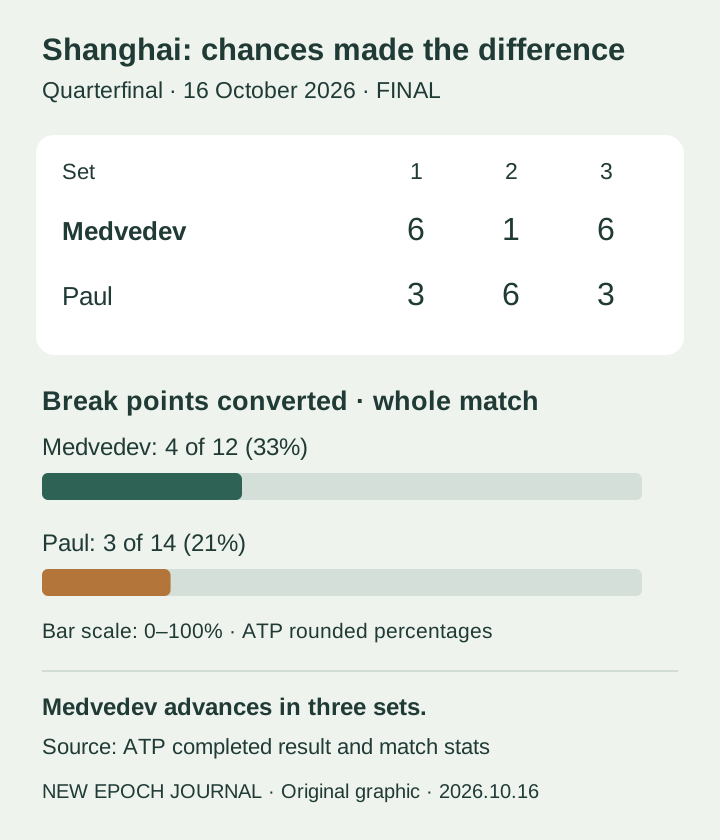
Paul’s 6–1 response forced a decider
The three sets changed the direction of the contest twice. Medvedev took the opener 6–3, Paul answered 6–1, and Medvedev took the deciding set 6–3. Paul’s middle set therefore kept the contest alive; it did not carry forward as a games advantage in the final set. Across all three sets, Medvedev won 13 games and Paul 12, calculated from the official score.
The same closeness appears in the points: Medvedev won 94 of 182, against Paul’s 88. The six-point difference helps explain why the final two-sets-to-one result should not be read as dominance throughout. Paul won the second set by five games, yet Medvedev won each of the other two by three. Tennis awards the match through sets, rather than the combined games total.
Break chances show the edge, with limits
Break-point conversion is the clearest difference in how the chances were used. Medvedev converted 4 of 12, while Paul converted 3 of 14. Read from the server’s side, Medvedev saved 11 of 14 and Paul saved 8 of 12. Paul had two more opportunities to break but finished with one fewer break. Those totals support an explanation based on handling break chances; they do not identify which individual rally decided the third set.
There are limits to that explanation. Medvedev hit 16 aces to Paul’s seven and won 74% of first-serve points to 69%, but he also made eight double faults against Paul’s one. Paul won a larger share of second-serve points, 41% against 36%. Medvedev’s win was therefore not a uniformly stronger serving performance: the advantage on first serves and break-point outcomes coexisted with clear weaknesses.
Jodar is next in the official draw
ATP’s draw now pairs Medvedev with Rafael Jodar in the semifinals, and shows Paul’s quarterfinal run ending here. Readers can use the linked official match page to check the completed statistics and the tournament draw to follow the next round. This report does not establish an Indian television or streaming offer, and no semifinal start time is claimed from a draw that identifies the pairing.
The result answers the central question: Paul’s 6–1 response was substantial, but he did not turn enough of his break chances into a second set won. Medvedev finished with more breaks and six more points overall, despite his double faults. That combination explains the narrow statistical edge behind the three-set win; the next test is whether he can retain that effectiveness against Jodar, not whether this result guarantees the same performance again.
ATP’s completed official result, match statistics and draw were read directly after the upper match-page source. Match facts, participant assessment and next-round status are distinguished. No Indian broadcast offer is inferred. The score graphic is original.
AI assisted with drafting and editing. This article is part of our preview edition. Editorial standards & corrections →