UK long-term net migration fell to a provisional 77,000 in the 12 months to June 2026, down from a revised 204,000 a year earlier. The Office for National Statistics published the estimate on 26 November. It was the lowest since 1997 when the pandemic period is excluded.
Net migration measures long-term arrivals minus long-term departures. The ONS counts people moving to or from the UK for at least 12 months. Its latest estimates put arrivals at 738,000 and departures at 661,000.
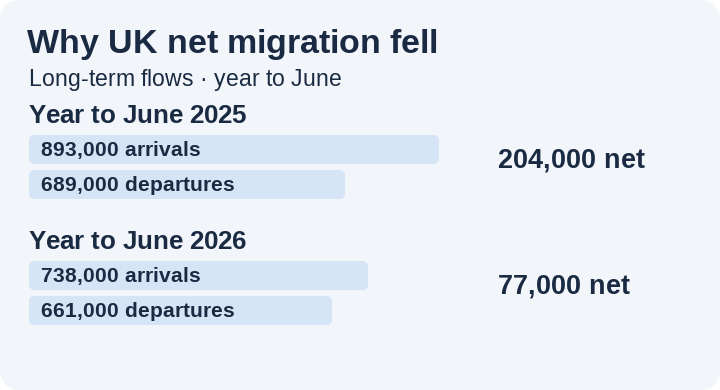
Fewer arrivals drove the fall
Long-term arrivals fell from 893,000 to 738,000, while departures were broadly stable at 661,000, compared with 689,000 a year earlier. The decline in the net figure was about 127,000, or 62% using the rounded published estimates. Lower non-EU+ immigration accounted for most of the fall in arrivals. The ONS reports fewer non-EU+ arrivals for work, study and asylum-related reasons.
The 1997 comparison needs two qualifications
The ONS excludes the pandemic period because it included exceptional travel restrictions. The agency also measured migration differently in 1997, relying on passenger surveys. Recent estimates use administrative records, including visa and border data. For June 2026 the ONS gives a 90% revision-based interval of 31,000 to 128,000. Delayed data meant it used a longer projection for the movement of British nationals.
What to compare in the May update
Use the June-to-June series in the ONS dataset for a like-for-like annual comparison. The next bulletin is scheduled for 27 May 2027, when the ONS expects to have more up-to-date data for British nationals. The clearest comparison in this release is the drop in arrivals alongside broadly stable departures. Future revisions can change the size of the gap.
The editorial desk checked the official sources and reader links.
AI assisted with drafting and editing. This article is part of our preview edition. Editorial standards & corrections →