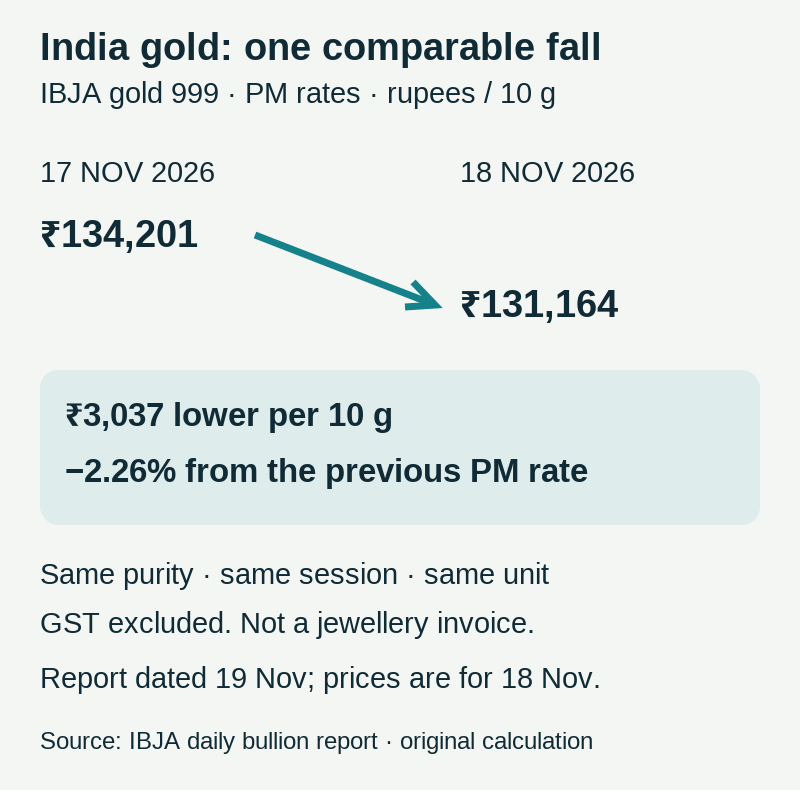
India’s gold decline reflects a broader global selloff, with currency movements also affecting the rupee price. The World Gold Council points to rate expectations, dollar strength and investor selling as recent pressures. A clean local comparison is IBJA’s gold 999 PM rate: ₹131,164 per 10 grams on November 18, down ₹3,037, or about 2.26%, from November 17, excluding GST.
The correction is drawing attention on November 19, but a report’s publication date is not always its price date. The IBJA bulletin dated November 19 explicitly labels its Indian spot rates as November 18. That distinction matters when comparing a recent fall with a shop quote or a same-day market rebound.
What the local benchmark actually measures
IBJA lists the same gold 999 PM series at ₹134,201 on November 17 and ₹131,164 on November 18. The calculation is (131,164 − 134,201) ÷ 134,201 × 100, giving approximately −2.26%. Both observations use rupees per 10 grams and exclude GST. This is a previous-day benchmark comparison, not a live November 19 retail offer.
The same bulletin lists an AM rate of ₹131,505 for November 18. Comparing that morning value with the PM value answers an intraday question; comparing two PM values answers a day-to-day question. Jewellery with a different purity and a bill containing making charges is another comparison again. The date, session, purity and unit must stay aligned.
Why the rupee changes the Indian picture
In its November 17 update, the World Gold Council says international prices fell 6.3% in October. It reports a further 1% decline through November 12, while domestic prices fell 5.3% over that November interval. It attributes part of the difference to the rupee strengthening 1.7% since October ended. Those figures stop on November 12, so they do not measure the full decline through November 19.
Gold provides no interest payment, so a stronger expected return on interest-bearing assets can reduce its relative appeal. Exchange rates add another layer to the local price. These mechanisms explain why Indian and dollar-denominated returns can differ; they do not identify the cause of every trade. The Council also reports continued Indian gold-ETF inflows, a reason not to equate falling prices with every type of demand disappearing.
Use the correction to improve the comparison
For a purchase comparison, ask for the quote’s date and time, purity, net gold weight and unit price, then separate making charges and taxes. Compare matching purities and weights before applying a headline percentage fall to a jewellery bill. A percentage measured from a January peak cannot be substituted for the one-day change calculated here.
The evidence supports a recent decline in a clearly specified local benchmark and several plausible market pressures, not a guaranteed next move. The next useful observation is another like-for-like IBJA PM rate alongside the rupee and global benchmark. Keeping those series separate gives a sounder reading of the correction than calling a rebound the end of the decline or a lower quote a proven buying opportunity.
Dates, scope and conditions are stated with their source; prices are dated benchmarks or advertised starting prices.
- IBJA: daily bullion report dated19November2026 ↗
- World Gold Council: India gold market update,17November ↗