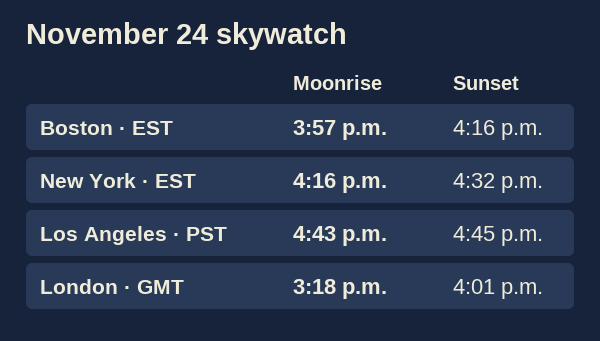
Look toward the eastern horizon late on Tuesday afternoon, November 24, 2026, for the Beaver supermoon. The U.S. Naval Observatory puts moonrise at 3:57 p.m. in Boston, 4:16 p.m. in New York, 4:43 p.m. in Los Angeles and 3:18 p.m. in London, all in local time.
The observatory puts the exact full phase at 14:53 UTC on November 24, or 9:53 a.m. EST, 6:53 a.m. PST and 2:53 p.m. GMT. That time describes the Moon’s phase. When it clears the horizon depends on where you are.
Why moonrise comes at a different time
NASA lists the November 24 full Moon as a supermoon. The name describes a full Moon near the closest part of its elliptical orbit around Earth. NASA’s supermoon calendar lists 14:54 UTC, a minute later than the observatory’s phase table. The times in this guide use the observatory for both the phase and the city calculations.
Sunset is at 4:16 p.m. in Boston and 4:32 p.m. in New York. It is at 4:45 p.m. in Los Angeles and 4:01 p.m. in London. By those calculations the Moon rises between two and 43 minutes before sunset in the four cities.
Where to look on Tuesday
Choose a spot with an open view to the east before moonrise. Buildings or hills can hide the Moon while it is low. Give it a little time to climb or move to a place with a clearer view.
Outside the four cities, enter your location and November 24 in the U.S. Naval Observatory’s Sun and Moon tool. The moonrise and sunset entries together show how much daylight to expect when the Moon comes up.
If clouds move in
To the naked eye the Moon still looks nearly round hours after its exact full phase. If the east is clouded over on November 24, check the next day’s local moonrise and cloud forecast before trying again.
The minute listed for each city is calculated for its reference coordinates. Your horizon and local cloud cover determine when you will actually see the Moon.
U.S. Naval Observatory city calculations and phase table, with NASA’s supermoon listing cross-checked.
- U.S. Naval Observatory lunar phases ↗
- NASA supermoon calendar ↗
- USNO Boston rise and set ↗
- USNO New York rise and set ↗
- USNO Los Angeles rise and set ↗
- USNO London rise and set ↗
- USNO sunrise and moonrise calculator ↗