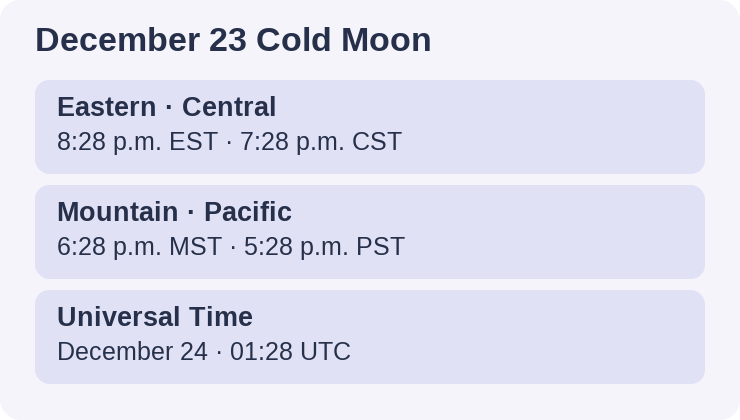
The December 2026 Cold Moon reaches its full phase on Wednesday, December 23, at 8:28 p.m. Eastern in the United States. That is 7:28 p.m. Central, 6:28 p.m. Mountain and 5:28 p.m. Pacific. The U.S. Naval Observatory lists the same instant as 01:28 Universal Time on Thursday, December 24.
After the November full moon on November 24, the next one falls just before Christmas. The date printed in a calendar depends on its time zone. The best time to step outside depends on when the Moon rises where you are.
Why both dates are used
The full phase is a single point in the lunar cycle. At 01:28 Universal Time on December 24, the contiguous United States is still on December 23. Subtract five hours for Eastern Standard Time, six for Central, seven for Mountain and eight for Pacific. The Catalina Sky Survey calendar marks the Moon as full on both December 23 and 24, which also shows how little the visible phase changes across adjacent nights.
Moonrise is a local event
The phase time tells you when the Moon is fullest. It does not tell you when it clears a ridge or the buildings on your street. Use the Naval Observatory’s rise-and-set calculator with December 23 and your location, then find the moonrise entry. Near a full moon, look toward the eastern horizon around dusk if local conditions permit.
Choose the viewing window around conditions
For a view low on the horizon, plan around the local moonrise and find a clear eastern view in daylight. You can also look later in the evening. If clouds spoil Wednesday, Thursday is a reasonable second chance because the Moon will still look nearly full, though its rising time will have shifted.
The phase instant comes from the U.S. Naval Observatory. The US times use the four corresponding standard offsets.
- US Naval Observatory 2026 lunar phases ↗
- University of Arizona Catalina Sky Survey calendar ↗
- US Naval Observatory rise-and-set calculator ↗