England’s one-off £100 Household Energy Payment will start being paid from 4 January 2027. Core eligibility covers qualifying households whose sole or main home is in council-tax bands A–D on that date. Jointly liable adults receive one payment per household, not £100 each, and the start date is not a promise that every eligible household will be paid on 4 January.
The government announced the delivery arrangements on 24 November as support with winter energy costs. Councils will distribute the payment to about 20 million households in England; around 13 million with verified direct-debit details are expected to receive it automatically. Scotland, Wales and Northern Ireland receive corresponding funding, but their governments determine their own arrangements.
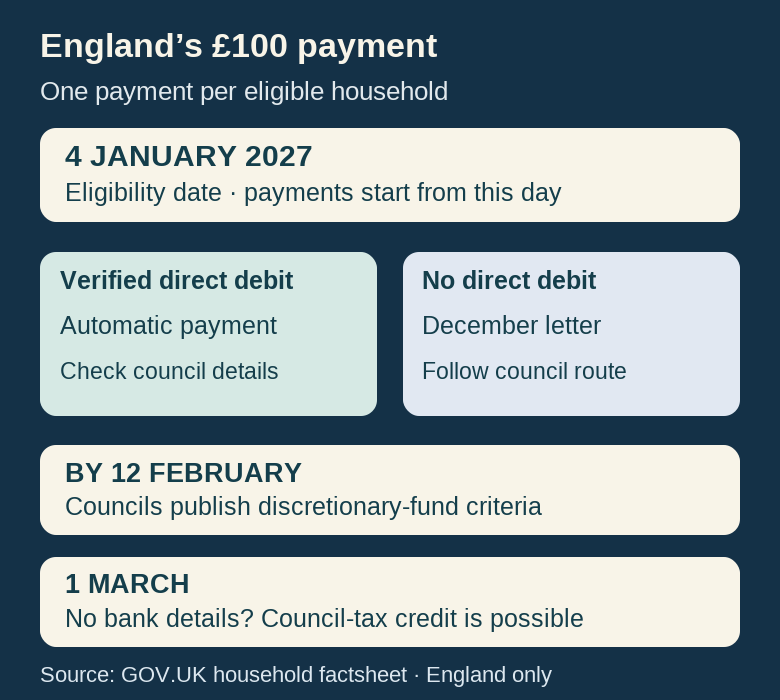
Direct debit determines the first payment route
The government says using council-tax records allows payments to reach households quickly as the energy price cap changes. Eligible households whose council holds verified direct-debit bank details will be paid automatically. The bank-statement reference is GOV ENERGY PAYMENT. A 100% council-tax discount does not itself disqualify a household, and student-only homes can also qualify if they meet the other conditions.
Councils will write in December to households that do not pay by direct debit, explaining how to provide bank details. All eligible households will also receive a letter in January. Follow the route supplied by your council: the government’s Find your local council service provides the official starting point for locating its payment guidance.
Missing bank details and landlord-liable homes
If a council has not obtained bank details by 1 March 2027, it can credit the £100 to the council-tax account. A household that does not want to supply bank details can use this route too. The credit can offset council tax or be reclaimed, so an automatic cash transfer is not the only way to receive support.
Where the landlord is liable for council tax in a house in multiple occupation, neither the landlord nor the residents receive the core payment for that property. This differs from a qualifying household receiving a full discount or student exemption. The housing arrangement and council-tax liability matter; whether someone currently pays a bill is not enough to decide eligibility.
Discretionary support has separate local criteria
A £100 million Discretionary Fund will allow councils to offer additional support. The government has asked councils to publish their local criteria by 12 February 2027. People excluded from the core scheme, including some residents of landlord-liable HMOs, may receive help, but eligibility depends on the council’s criteria and is not guaranteed for every excluded household.
Start with the main home, council-tax band and liability on 4 January, then follow the council’s bank-detail instructions. If the core rules exclude your household, look for the local discretionary criteria. Those steps turn the national payment-start announcement into a practical route for checking your own position.
Based on the government’s November 24, 2026 announcement and household factsheet. The eligibility and payment routes described here apply to England.
AI assisted with drafting and editing. This article is part of our preview edition. Editorial standards & corrections →