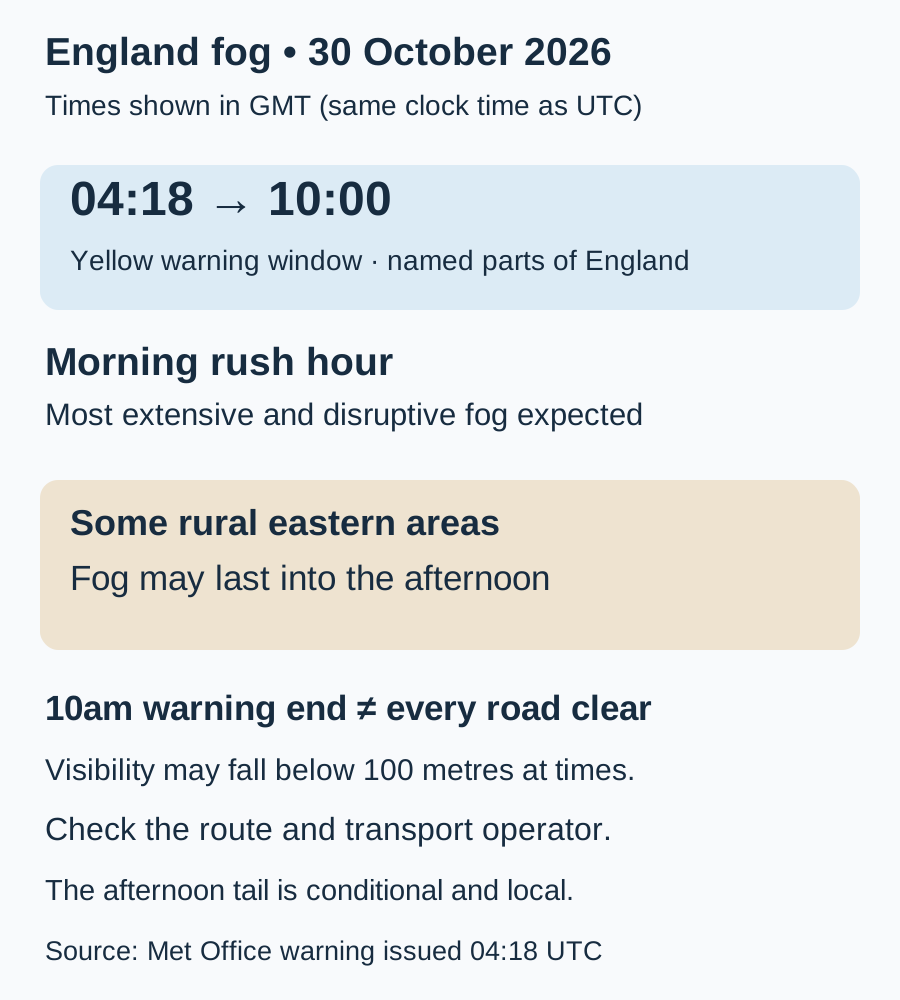
A Met Office yellow fog warning is valid until 10 am GMT on Friday,30 October 2026, for parts of England. Visibility may fall below 100 metres at times, with the most extensive and disruptive fog during the morning rush hour. Some rural spots in eastern England may keep fog into the afternoon, after the warning’s stated end.
The warning was issued at 04:18 UTC on 30 October and became valid at that time. The UK is on GMT for this date, so the 04:18–10:00 UTC window has the same clock times locally. For a morning journey, the distinction between the warning window and later clearing is useful:10 am is the end of this warning, not a promise that every road will be free of fog.
Check the named area and the service
The notice lists affected local authorities in the East Midlands, East of England, London & South East England and West Midlands. These are regional labels with specific areas beneath them, rather than a warning for the whole UK. Norfolk, Suffolk, Cambridgeshire, Warwickshire and the West Midlands Conurbation are among the named places; travelers should use the official map and locality list for their route.
The forecast impact is slower journeys and possible delays to buses and trains, alongside possible flight delays or cancellations. The wording describes a risk, not a report that every service has been disrupted. No specific flight, train or road closure is confirmed in this article; an operator’s current notice remains the source for a particular booking.
The end of the warning is not universal clearing
The Met Office expects fog to thin, lift and clear gradually later in the morning, with the rural eastern-England exception lasting into the afternoon. The contrast is between local clearing times, not two conflicting national forecasts. A driver crossing several areas may encounter different visibility even within the same morning.
The adopted warning does not give a detailed physical explanation of how this fog formed. Its practical message rests on the expected visibility and timing. Likewise, a yellow warning should be read with its stated impacts and location; the colour alone cannot identify the condition of a particular road or the status of a flight.
Make the journey decision locally
The Met Office advises checking road conditions, allowing extra journey time and changing plans if necessary. It also advises knowing how to turn on the vehicle’s fog lights and checking that they work before departure. Bus, rail, air and ferry passengers should consult the travel company’s updates and follow its advice for their service.
For 30 October, the travel decision should combine the local forecast and visibility with the route or operator report. The warning’s 10 am end is a useful milestone, but the stated rural afternoon exception is reason to retain flexibility after that point. A later departure may improve conditions in some places; it is not a universal clearance time.
The dated official sources below define the scope. Scheduled or forecast events are identified as such; subsequent changes will be updated at this URL.
AI assisted with drafting and editing. This article is part of our preview edition. Editorial standards & corrections →