The IRS has announced 2027 federal income tax thresholds while keeping the seven marginal rates at 10% through 37%. The standard deduction is $16,600 for single filers and married people filing separately, $33,200 for joint filers, and $24,925 for heads of household. These are tax-year 2027 amounts, generally used on returns filed in 2028.
The November 5,2026 release makes annual inflation adjustments to almost 70 provisions. For households planning next year, the change is in the dollar thresholds and deduction amounts rather than a new set of ordinary-income rates. Returns filed during 2027 generally concern 2026 income and need that year’s figures instead.
2027 federal ordinary-income bands
| Rate | Single taxable income | Joint taxable income |
|---|---|---|
| 10% | Up to $12,800 | Up to $25,600 |
| 12% | Over $12,800 to $52,025 | Over $25,600 to $104,050 |
| 22% | Over $52,025 to $109,125 | Over $104,050 to $218,250 |
| 24% | Over $109,125 to $208,325 | Over $218,250 to $416,650 |
| 32% | Over $208,325 to $264,550 | Over $416,650 to $529,100 |
| 35% | Over $264,550 to $661,375 | Over $529,100 to $793,650 |
| 37% | Over $661,375 | Over $793,650 |
USD. Each rate applies only to the portion in that band. Other filing statuses use separate schedules.
Choose a filing status and the taxable-income band
For a single filer,10% applies through $12,800 of taxable income; the 12% band begins above that and runs through $52,025. The next thresholds are $109,125 for the 22% band, $208,325 for 24%, $264,550 for 32%, and $661,375 for 35%; income above $661,375 enters 37%. The table gives the corresponding joint-filer bands, which use their own thresholds.
These rates apply in layers, as the IRS explains in its bracket guide. Only the portion entering a higher band receives that band’s rate. Start with taxable income after applicable deductions, then apply each rate to the portion falling inside its band.
An example shows what the rates actually do
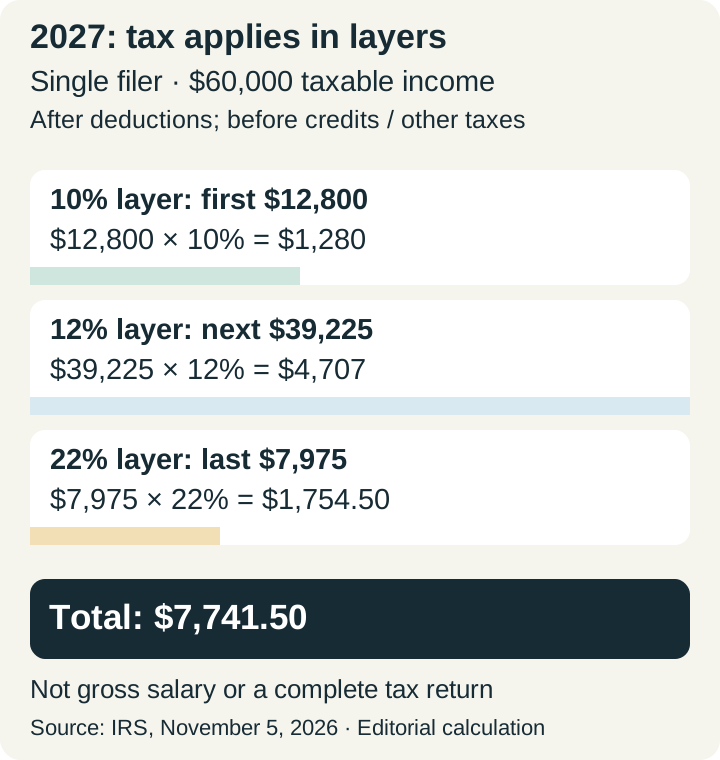
For an illustrative single filer with $60,000 of taxable ordinary income in 2027, the first $12,800 at 10% produces $1,280; the next $39,225 at 12% produces $4,707; and the remaining $7,975 at 22% produces $1,754.50. Those layers total $7,741.50 before credits and other taxes. The $60,000 is already taxable income, so the standard deduction is not subtracted again in this calculation.
The standard deduction is a separate step in arriving at taxable income:$16,600 for single or married-separate filers, $33,200 for joint filers and $24,925 for heads of household. The IRS says the joint amount rises $1,000 from 2026. A deduction amount is not itself a dollar-for-dollar reduction in the final tax bill.
Use the figures for the right year and question
For a 2027 estimate, select the appropriate filing status, work out taxable income and use the dated 2027 IRS release or Revenue Procedure 2026-35 linked there. The IRS bracket guide explains the layering principle, but its currently displayed 2025 table is not the 2027 threshold table. A different status, capital gains, credits or other taxes requires the corresponding rules rather than extending this simple example.
The announcement raises the income thresholds and standard deduction while retaining the seven ordinary rates. That changes how much income falls into each layer; it does not determine a household’s full tax liability or refund by itself. The useful comparison is the same filing status and tax year, with deductions and credits kept in their proper steps.
Prepared from the official records and attributed reporting listed below; dates, scope and limitations are retained.
AI assisted with drafting and editing. This article is part of our preview edition. Editorial standards & corrections →