Leylah Fernandez defeated Aliaksandra Sasnovich 7–5, 6–7(3), 6–3 at the Ningbo Open on 21 October, booking a quarterfinal against Ekaterina Alexandrova. The WTA recorded a match time of three hours and three minutes. Its official singles draw confirmed the pairing when checked on 22 October.
The result in Ningbo, China, gives Fernandez her fifth quarterfinal of 2026 and her first at this tournament, according to the WTA recap. It also brings an immediate test against last year’s runner-up after two demanding wins. For readers catching up on the result, the distinction matters: Sasnovich was her round-of-16 opponent; Alexandrova is the next opponent shown in the draw.
Ningbo: result and next match
| Item | Confirmed detail |
|---|---|
| Round of 16 | Fernandez beat Sasnovich 7–5, 6–7(3), 6–3 |
| Quarterfinal | Fernandez vs Ekaterina Alexandrova |
| First two matches | Fernandez 5h52; Alexandrova 1h53 |
| Next start time | Not listed in the official order of play at our 22 October check |
The 3h59 difference compares the first two matches only. It does not measure recovery or predict the quarterfinal result.
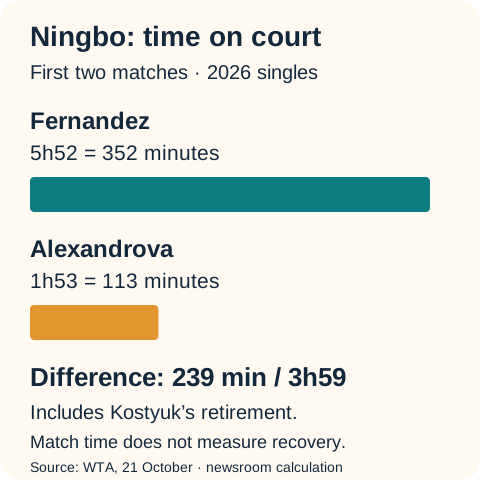
Two routes to the same quarterfinal
Fernandez had already come through three sets against Elise Mertens, winning 2–6, 6–3, 7–5 in the opening round. Against Sasnovich she recovered from 5–3 down in the first set, lost the second-set tie-break and then completed another three-set win. The two results explain why so much of the discussion around her quarterfinal centres on time spent competing.
Alexandrova’s draw shows a 6–2, 6–3 opening win over Guo Hanyu, followed by Marta Kostyuk’s retirement after Alexandrova took the first set 6–4. The official draw records that second-round match at 6–4, 0–0. Her route therefore includes a shortened match, an important qualification when comparing the two players’ totals.
What the time gap does—and does not—show
The WTA reported five hours and 52 minutes on court for Fernandez across her first two matches, against one hour and 53 minutes for Alexandrova. Converted to the same unit, those totals are 352 and 113 minutes: Fernandez has played 239 minutes, or three hours and 59 minutes, more. This is a comparison of match duration across the same two rounds, rather than an estimate of practice, recovery or physical condition.
That difference gives the quarterfinal context but does not determine its winner. A retirement affects the total without showing how much energy either player will have for the next match. The useful question when play begins is how Fernandez handles another contest after two long wins; the time figures alone cannot establish fatigue or a medical problem.
The draw confirms the opponent; the schedule sets the time
To follow the next fixture, use the WTA singles draw for the confirmed pairing and its order-of-play page for the assigned court and start conditions. At this article’s 22 October check, the published daily schedule ran through 22 October and did not list a start time for Fernandez–Alexandrova. There is consequently no verified US or UK start time to convert here; the date and court order need to be published first.
Fernandez’s win is settled, and Alexandrova is the confirmed next opponent. What remains open is the quarterfinal’s start time and how the contrasting routes will translate into play. Keeping the result, the bracket and the daily schedule separate lets readers follow the match without mistaking an unposted time—or a large duration gap—for a confirmed outcome.
Official WTA recap, singles draw and daily order of play checked on 22 October 2026. Duration comparison calculated by the newsroom; no broadcast rights or unposted start time inferred.
- WTA · Fernandez’s marathon win, 21 October 2026 ↗
- WTA · Ningbo 2026 singles draw ↗
- WTA · Ningbo order of play ↗