Pierre Sage accepted responsibility and apologised to Crystal Palace supporters after a 5–0 defeat at Brighton on October 18. Palace conceded three goals inside the opening ten minutes at the Amex. In the club’s published reaction, Sage said the team had not competed as it should and that his preparation needed to be better.
The derby made the scale of the collapse particularly painful for travelling supporters. Sage said the history of the fixture had been discussed beforehand, yet Palace failed to produce the expected performance. His apology therefore addressed both the result and the gap between the occasion’s importance and the team’s response.
How the score developed
| Phase | Score and event |
|---|---|
| Opening ten minutes | Brighton 3–0: own goal, Gomez, Ayari |
| Early second half | 4–0: Kostoulas |
| Closing stages | 5–0: Hinshelwood |
Brighton’s official report places the third goal at 9 minutes 30 seconds. All scores are Brighton–Palace.
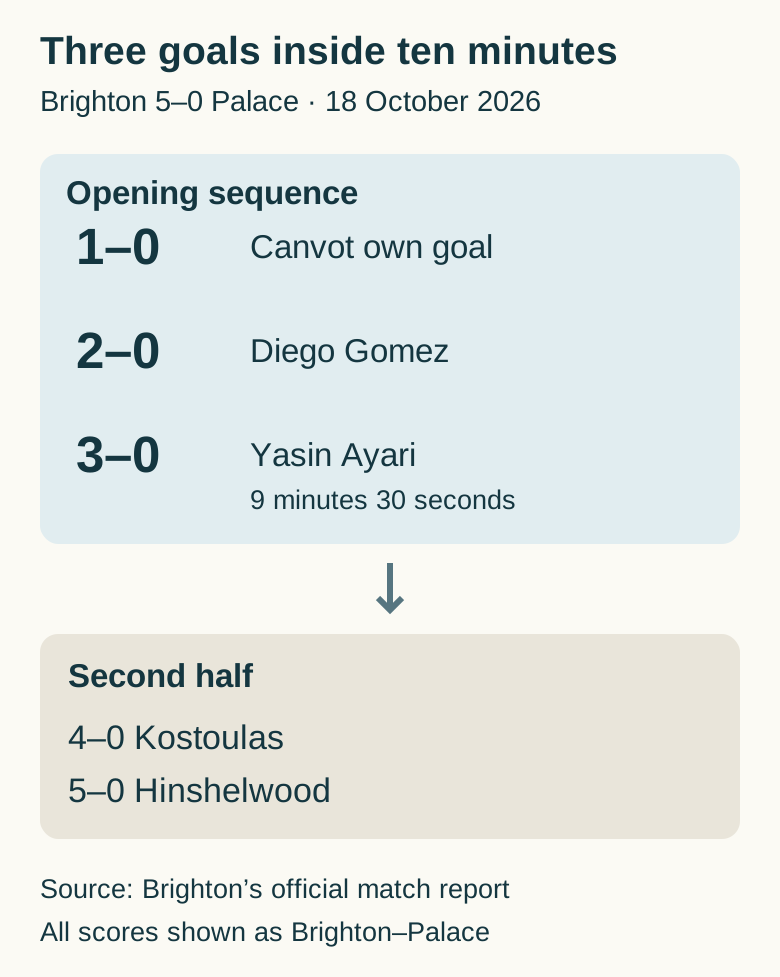
The opening sequence left Palace three down
Brighton’s official report describes three distinct blows: Jaydev Canvot headed a free-kick into his own net, Diego Gomez scored from near halfway, and Yasin Ayari finished a move across the goal. Brighton put the third at nine minutes and 30 seconds. That sequence explains why the start dominated Sage’s postmatch assessment.
The damage continued after the interval. Babis Kostoulas made it four early in the second half and Jack Hinshelwood added the fifth late on. Brighton also recorded Jean-Philippe Mateta hitting the bar for Palace. The missed chance supplied no recovery on the scoreboard, and the match finished without a Palace goal.
What Sage said needed to change
Sage’s own explanation focused on preparing the players better and giving them more solutions. He also called for greater confidence and aggression. Those are the coach’s stated priorities after the defeat, rather than independent proof that one tactical choice caused every goal. They give substance to his acceptance of responsibility.
BBC Sport’s Michael Emons reported that Palace were 14th with two wins from seven league matches and 17 goals conceded. That wider record helps explain why questions extended beyond a single bad afternoon. The report also said Sage did not know whether he would be given time to improve the situation.
Accountability and the unanswered job question
The useful next test is whether Palace’s performance reflects the changes Sage has identified: better preparation, more ways to respond and stronger competition from the start. The club’s linked reaction supplies his own account; Brighton’s report supplies the scoring sequence, and the BBC report explains the questions about his position.
What is established is an emphatic derby defeat and a coach publicly taking responsibility for how his team approached it. His uncertainty about being given time does not establish a dismissal. The immediate football issue is how Palace address the opening collapse; any decision about Sage’s employment requires a separate club announcement.
Coach comments verified against Palace; scoring sequence against Brighton; season and job context attributed to BBC Sport.
- Crystal Palace: Sage apologises to supporters ↗
- Brighton: Albion 5 Crystal Palace 0, Bruce Talbot ↗
- BBC Sport, Michael Emons, via Yahoo Sports ↗