I often use software and wish I could change just one feature to suit the way I work. The behavior I want is visible, yet explaining and rebuilding it are separate challenges. The familiar division of labor—users choose features and software companies decide how they work—rests partly on that gap.
REA case studies published in October 2026 show a way to narrow it. Reverse Engineer Anything helps AI agents investigate existing software and connect findings to evidence. The change that interests me is a broader starting point for development: alongside requirements and available source code, there is the verifiable behavior of software already running.
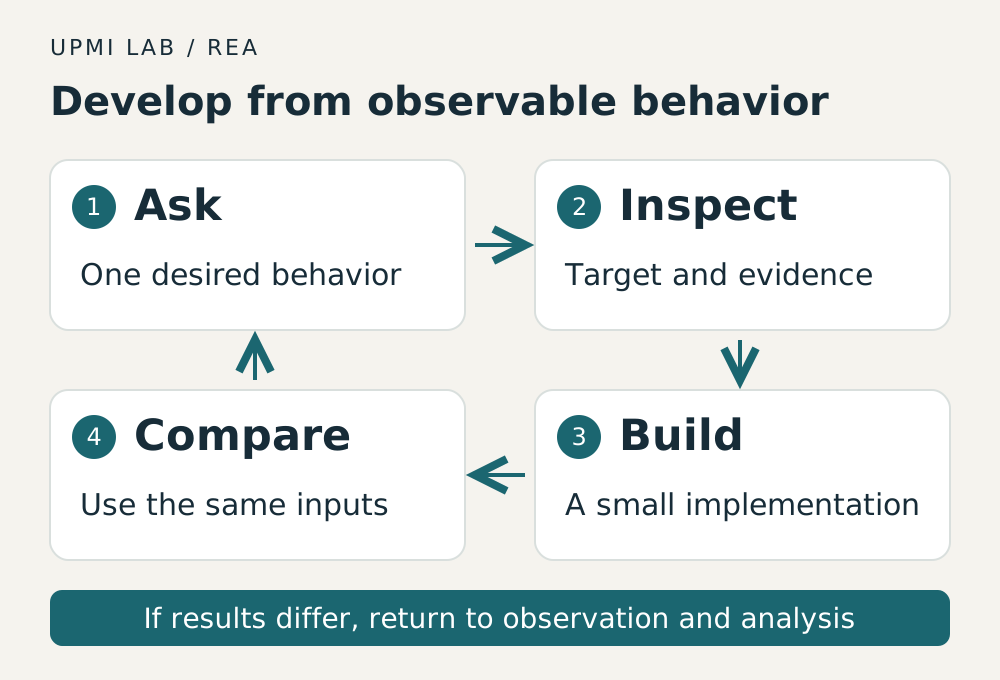
A user’s question becomes a unit of implementation
REA connects analysis of binaries, JavaScript and Electron applications through MCP and a command-line interface. Agents use functions, references and source locations to guide further investigation or implementation. This is the role described in the official repository; it does not promise automatic recovery of an entire application’s original source.
The size of the question matters. Asking what a program saves and how it restores those values defines a more testable task than asking for an identical app. With clear inputs and outcomes, the user can compare expected behavior against a new implementation. A preference becomes a condition that can be tested.
Writing new code and understanding an unfamiliar program have traditionally required distinct skills. An agent that moves between them could lower the barrier to a small compatibility feature or a personal tool. That is an inference from the published workflow, rather than a measured reduction in the cost of every project.
What makes a small success credible
REA’s DX-Ball showcase reconstructs one sound-panning function in C. It reports matching outputs in 3,205 cases and 63 matching recompiled bytes. Those checks support a claim about that function, not a claim that the entire game is finished.
The Notion Desktop 7.6.1 example follows a clipboard request through preload code and interprocess communication to the system clipboard. Its evidence consists of packaged code and extracted-module tests, rather than observation of a complete desktop session or a reconstruction of the whole service.
The Touhou 4 example makes another boundary visible. REA inspects bullet-angle calculations in a DOS executable. The maintained C++ and checks matching 2,139 compiled bytes come from the existing reconstruction project. REA adds an investigation route to work already accumulated by that project.
All three cases explain not only what was discovered, but what it was compared against. I consider this more durable than an impressive demonstration screen. When someone else can test the same scope again, a one-time success becomes knowledge that subsequent work can rely on.
People recovering a useful piece of a product
On October 9, Kintu gk described building an Android shortcut for Sony headphone wind-noise reduction using Codex and REA. Where analysis failed, existing public protocol references helped; settings were read back from the device. This is the author’s account, not an independently reproduced test for this essay.
UPMI Lab’s Princess Maker 2 project also began with a specific use. Its separate contribution describes retaining the original game execution while changing the presentation and controls and installing it on an iPad mini. After REA analysis, artwork production and integration, app changes, building, signing and installation continued in the Codex Work workspace. UPMI Lab operates that project.
Neither experience set out to replace a large company’s entire product. The aim was to simplify a frequent action or bring an old experience to a current device. Such requests may be too small to become priorities in a commercial roadmap. Participation in implementation gives more people a way to address precisely these modest needs.
Faster development makes responsibility for verification clearer
Understanding behavior and taking responsibility for a product remain different levels of work. One saved file may open while a different version fails. A matching screen says little about input timing or recovery from errors. As implementation expands, failed conditions need to be recorded alongside successful examples.
I propose keeping three things with a verification record: the original version examined, the inputs and outputs compared, and the areas not yet tested. If local files cannot explain a server-side behavior, that boundary belongs in the implementation plan. An unknown omitted from the design can become a cost at the next change.
Local analysis also does not describe every movement of data. REA’s FAQ says that the model provider’s policy applies to findings received by the agent. Organizations therefore need to decide what information their targets and results contain. Understanding functionality and establishing a basis for distributing original code or artwork are separate tasks too.
The value a software company provides becomes more specific
It is premature to read this as the disappearance of software companies. Users purchase continuity with old files, support when things fail and connections to collaborators, as well as functions. Even if similar features become quicker to build, responsibility for carrying accumulated work forward remains.
Conversely, difficulty reproducing an isolated feature may become a less durable advantage. I expect a useful response to include investment in documented interfaces, dependable exports, automation and verification evidence. When customers can extend their workflows, a company can explain more concretely why they should keep choosing its product.
Development teams should reconsider their measures of progress too. Behavior confirmed with real files and devices, compatibility retained after a change and time needed to recover from a failure are more useful than the volume of generated code. This is a proposal about where human judgment belongs as automation expands.
The next project starts with a more precise need
A practical first REA project starts with a target you are entitled to use and one troublesome behavior. Preserve the original, build a small implementation and compare both with the same inputs. Keep evidence and test material so a mismatch can lead back to investigation. That cycle remains useful to the next developer even when the tools change.
I would not judge REA’s influence only by the size of a program someone claims to have replicated. A larger change is more people being able to turn an observed problem into an investigable question, then connect its answer to something executable. The next chapter of software development will be shaped by faster code production together with the ability to explain why that code keeps doing the intended job.
This contribution draws on official documentation and public accounts checked on October 24, 2026. External examples are their authors’ records, distinguished from UPMI Lab’s own work. Industry forecasts and proposals are the author’s interpretation.
- REA · official repository ↗
- REA · DX-Ball sound-panning study ↗
- REA · Notion clipboard study ↗
- REA · Touhou 4 study ↗
- Kintu gk · Sony headphone experiment ↗
- UPMI Lab · Princess Maker 2 project ↗
- REA · FAQ and data policy ↗