United Airlines says it has resolved the technology issue that delayed departing flights on November 16, according to an AP report updated at 8:13 a.m. Korean time on November 17. Passengers should still check the particular flight and departure date, then use the reservation’s rebooking options if the journey remains disrupted.
The disruption occurred on November 16 in the United States, corresponding to the following morning in Korea. The resolution announcement concerns the technology problem. For a passenger with a booked itinerary, the remaining question is whether that flight or connection has changed. United’s flight-status and disruption guides provide the routes for making that decision.
Use the advisory’s scope and the correct flight date
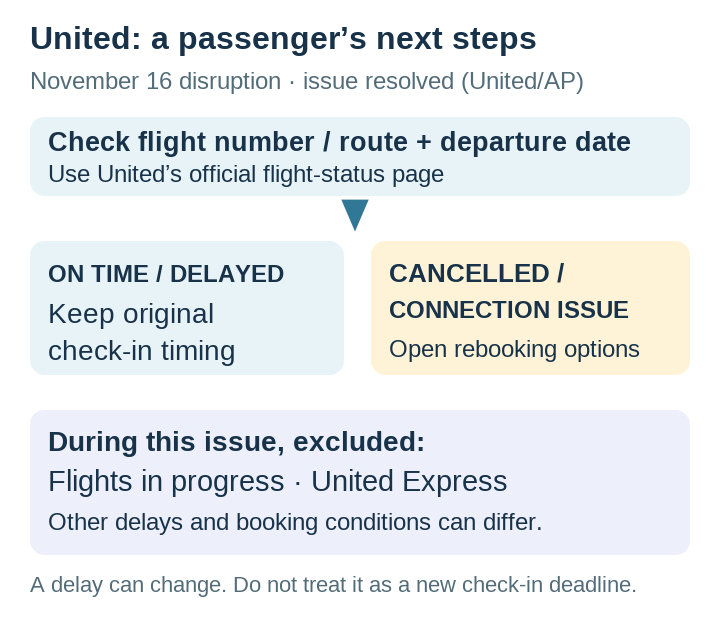
During the disruption, United’s own website advisory said flights already in progress and United Express regional services were not affected. That limits the scope of this incident. It does not establish that every mainline departure was cancelled, or guarantee that an excluded flight could not face an unrelated delay. The airline did not identify a technical root cause in that advisory.
United’s official flight-status page offers searches by route or flight number and includes a travel-date selector and airline selection. Use the departure date of the flight being checked, especially when reading news from another time zone. For a connection, check the onward flight as well as the first leg; a network-wide headline cannot supply either flight’s gate or departure status.
A delayed label is not permission to arrive late
The flight-status page warns that a flight shown as delayed may still depart on time as circumstances change. Unless the flight has been listed as cancelled, United recommends checking in for the original scheduled departure time. Passengers should therefore keep monitoring the flight rather than treating a delay estimate as a fixed replacement check-in deadline.
United’s disruption guide lists options for a cancelled flight, a delay of more than an hour, or a missed or potentially missed connection. In the app or website, “Rebooking options” or “View other flights” can show an alternative flight, standby choices, bag information, eligible vouchers and agent support. The presence of a voucher option does not mean every passenger qualifies for a hotel or meal.
Match the reservation options to this disruption
The travel-alerts page also carries a separate Nationwide ATC Outage waiver with original travel dates of November 13–15 and a ticket-purchase cutoff of November 12. Those dates do not establish an automatic waiver for a November 16 journey. Use the options displayed for the actual reservation; at the airport, United also lists kiosks, Agent on Demand and gate agents as support routes.
The practical decision rests on two pieces of information: the current status of the booked flight and the alternatives offered for that booking. Keep the original check-in plan while a flight remains merely delayed, and use the reservation tools when cancellation or a connection problem changes the journey. The resolution announcement should be read alongside those flight-level details rather than assumed to clear every itinerary at once.
Based on the official records below. Forecasts, operational advisories, confirmed results and interpretation are distinguished.
- United travel alerts (earlier technology advisory captured) ↗
- United flight status: route or flight number ↗
- United missed, delayed and canceled flights ↗
- AP November17 08:13 KST: United reports issue resolved ↗