South Korea’s Ministry of Health and Welfare sets the 2026 Basic Pension eligibility threshold at ₩2.47 million a month for a single household and ₩3.952 million for a couple. The comparison uses assessed income, which includes an assessment of assets, rather than wages alone.
An October 3 Segye Ilbo report describes debate about linking eligibility to standard median income instead of targeting the lower-income 70% of people aged 65 and over. A number in a reform proposal, however, is not automatically the rule an applicant faces this year.
2026 application reference
| Item | Threshold / route |
|---|---|
| Single household | Up to ₩2.47million monthly assessed income |
| Couple household | Up to ₩3.952million monthly assessed income |
Eligibility thresholds are not benefit amounts; individual assessment applies.
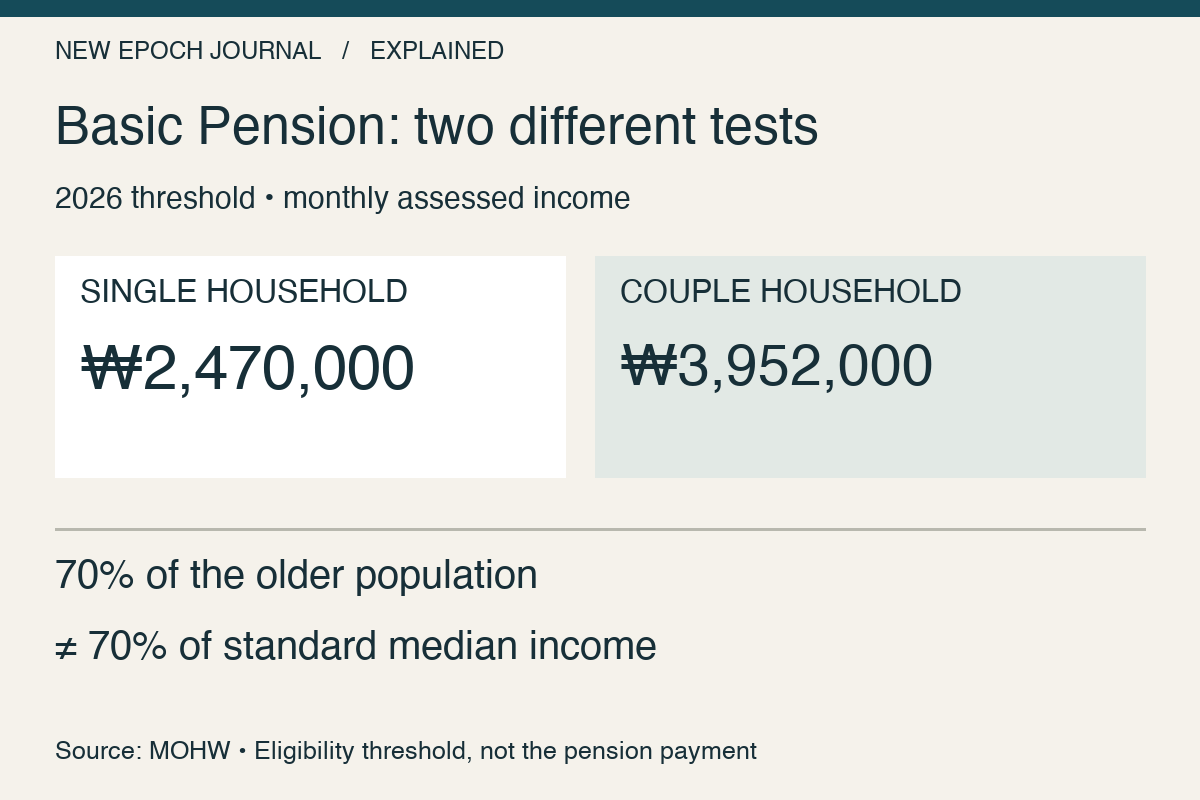
Two percentages with different denominators
The existing 70% describes the intended share of the older population covered. Applying a percentage to standard median income instead defines an income benchmark. “The lower-income 70% of older people” therefore cannot be read as “income below 70% of the median.”
The debate concerns whether to retain broad coverage or concentrate more support on poorer older people. Changing the coverage and changing payment levels may be considered together, but implementation depends on separate policy and legislative decisions.
A bill is evidence of debate, not a new eligibility rule
Bill 2220235, introduced on July 29, proposes changes using standard median income. The public legislative record shows that it was brought before the Health and Welfare Committee and referred to a subcommittee on September 11.
That record establishes a legislative proposal, not an enacted change. Treating a government discussion, a member’s bill and a final law as a single policy risks confusing both eligibility and the date a change would take effect.
Apply against the rules that govern the current year
Applicants should first establish their household type and assessed income. The eligibility threshold is not the monthly pension payment, and low wages alone do not establish entitlement: assets and other elements also enter the assessment.
The ministry lists local welfare centres, National Pension Service branches and the Bokjiro website as application routes. People born in 1961 who turn 65 during 2026 may apply from the month before their birthday month. Those unable to visit can ask the National Pension Service about a home visit on 1355.
The practical response is to seek assessment under this year’s rules, rather than delay solely because reform is in the news. Future announcements should be read for their enacted status, start date and treatment of existing recipients—not just the headline percentage.
Official records were checked against the linked reporting. Proposals, playback access and unverified details are not presented as established facts.
AI assisted with drafting and editing. This article is part of our preview edition. Editorial standards & corrections →