October’s Hunter’s Moon reached its full phase at 04:12 GMT on Monday, 26 October 2026: 12:12 am EDT on the US East Coast and 9:12 pm PDT on Sunday, 25 October, on the West Coast. The precise moment has passed, but the Moon can still look full on Monday evening. For readers in the UK and US planning to go outside, the useful next step is to find their local 26 October moonrise rather than wait for another peak.
The seasonal name gives this month’s Moon its autumn context. NASA links the Hunter’s Moon tradition to hunting by moonlight as fields became bare and daylight shortened. It is a name associated with the season, not a requirement to observe at one minute of the night. This week’s event is the 26 October full Moon; as Halloween approaches, the Moon will be waning gibbous.
The same full-phase instant
| Place | Local date | Time |
|---|---|---|
| London | Monday 26 October | 04:12 GMT |
| New York | Monday 26 October | 00:12 EDT |
| Chicago | Sunday 25 October | 23:12 CDT |
| Denver | Sunday 25 October | 22:12 MDT |
| Los Angeles | Sunday 25 October | 21:12 PDT |
Phase times, not moonrise times. US cities are examples, not every US time zone. Local viewing depends on location and weather.
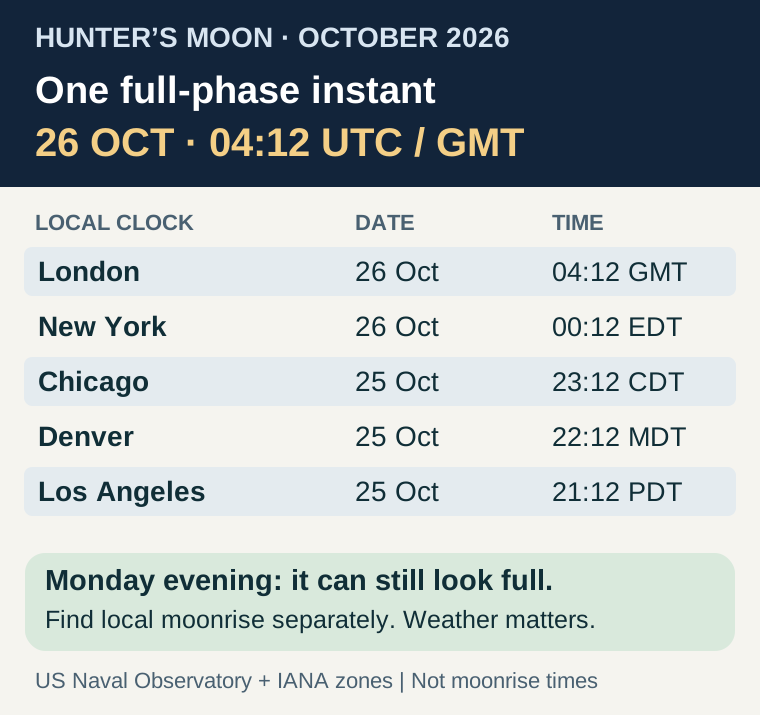
One full phase, different calendar dates
A full phase describes the Sun, Moon and Earth’s alignment. From Earth, the sunlit face of the Moon appears round, but that appearance changes gradually. The Royal Observatory Greenwich explains that it can still look full on the evening after the exact full-phase instant. Monday’s viewing opportunity therefore remains relevant even though the astronomical timestamp is already in the past.
The table below converts the US Naval Observatory’s 04:12 Universal Time to local clocks. London is on GMT for this event, while New York, Chicago, Denver and Los Angeles are still on their daylight-time offsets. That puts the instant on Monday in London and New York, but Sunday in the other three examples. Each entry describes the same moment; none is a moonrise time or a separate full Moon.
Use local moonrise to plan Monday evening
To plan a local observation, open the Naval Observatory’s “Complete Sun and Moon Data for One Day” service and enter 26 October 2026. US readers can import a city and state, then check the daylight-saving selection. For a UK location, enter its coordinates and use UTC/GMT for this date. The output supplies local rise and set times alongside the date and location, so the plan can be tied to the place where you will actually watch.
The service also reports the illuminated fraction at local noon. That noon value should not be read as the instant of full phase. Likewise, a listed rise time is an astronomical calculation, not a promise that clouds or the skyline will allow a view at that minute. Choose a place with an open view toward the Moon’s rising direction and check the local forecast before setting out.
What the low Moon can look like
Greenwich’s October guide notes that a low Moon may look orange because reflected sunlight passes through the atmosphere; the colour can fade as it climbs. The guide also describes naked-eye viewing, so a telescope is not needed merely to see the bright lunar disc. An orange appearance is a possible viewing effect, not a guarantee that every observer will see the same colour.
For Monday night, the decision is practical: match your local moonrise with a clear view and usable weather. The phase table establishes what happened at one global instant; the local rise-and-set result tells you when the Moon is above your horizon. Keeping those two times separate preserves the chance to enjoy the near-full Moon after its exact peak has passed.
Checked against the linked primary sources on 26 October 2026. Current status, scheduled dates and editorial interpretation are distinguished.
- US Naval Observatory: October 2026 lunar phases ↗
- Royal Observatory Greenwich: full Moon calendar and phase explanation ↗
- NASA: October skywatching and the Hunter’s Moon name ↗
- US Naval Observatory: local Moon rise and set calculator ↗
- Royal Observatory Greenwich: October observing guide ↗