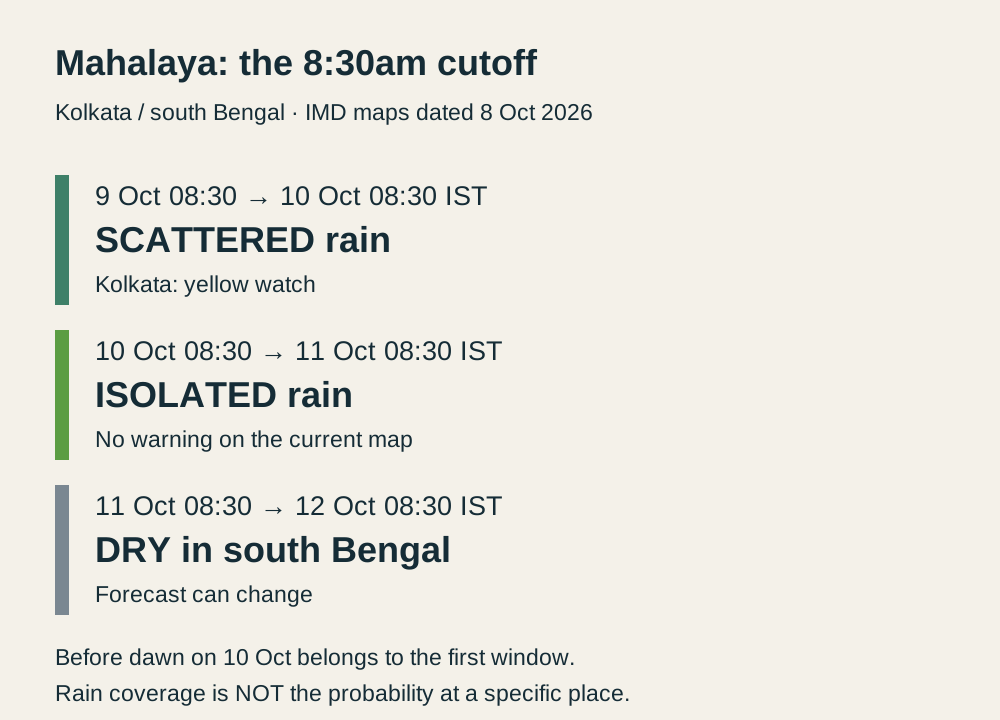
Mahalaya falls on Saturday, 10 October 2026, according to IMD’s Kolkata festival calendar. For Kolkata and south Bengal, the weather maps dated 8 October show scattered rainfall for the period ending at 8:30am IST on October 10, followed by isolated rainfall for the next 24 hours. A plan for dawn therefore falls under a different forecast window from a plan later that morning.
This distinction matters as families arrange travel and observances before the festival season. Reports on October 7 described wet weather leading up to Mahalaya, but an earlier warning is not automatically a warning for the whole of October 10. The current maps have both an issue date and a validity period; this report uses those printed periods rather than an AI summary’s single daily forecast.
Read the two windows before choosing an outdoor time
From 8:30am on October 9 to 8:30am on October 10, the south Bengal rainfall map is marked SCT, or scattered rain. Kolkata is also in a yellow “watch” area on the warning map for that period, with isolated thunderstorm and lightning symbols. Before-dawn activity on Mahalaya remains inside that window, rather than the map labelled Day 3.
From 8:30am on October 10 to 8:30am on October 11, the rainfall map marks West Bengal as ISOL, or isolated rain. The warning map covering Day 3 to Day 7 is marked “No Warning”. These two signals can coexist: an absence of a warning is not a forecast of no rain at every location. South Bengal is shown dry in the following window, from 8:30am on October 11 to 8:30am on October 12.
A coloured percentage describes coverage, not your personal odds
IMD groups spatial distribution as isolated at 25% or less, scattered at 26–50%, fairly widespread at 51–75%, and widespread at 76–100%. Its terminology defines these as the share of stations reporting or expected to receive rain in a region. Reading ISOL as a 25% probability of rain at your home or a particular riverbank changes the meaning of the forecast.
The maps also do not identify a guaranteed dry hour, the exact rain total at a venue, or the cause of every local shower. We therefore do not attach an unverified temperature, rain probability or storm track to the Mahalaya date. A useful decision combines the correct time window with a local update close to departure.
Use the official update to make a practical plan
For an early outing, keep rain protection and an indoor alternative ready, and check IMD Kolkata’s latest forecast and warnings before leaving. If a local warning or storm interrupts an exposed outdoor activity, postpone it or move the plan indoors. These are planning measures prompted by the warning, not a claim that all observances or transport services will be disrupted.
The official forecast PDF below is updated in place, so its printed issue date must be read again on October 9 or 10. The calendar also lists the start of Sharadiya Navaratri on October 11; that is a separate date from Mahalaya. The key follow-up is whether a newer map changes Kolkata’s warning or rainfall window. Until then, preserve the distinction between rain coverage, a warning and a guarantee about a particular location.
Based on IMD maps dated 8 October 2026 and its festival calendar; spatial rainfall categories refer to station coverage, not the chance of rain at one address.
- IMD Kolkata: forecast and warning maps dated 8 October 2026 ↗
- IMD Positional Astronomy Centre Kolkata: principal festivals ↗
- AajTak Bangla: weather report updated 7 October 2026 ↗
- IMD: spatial rainfall terminology (definition only, not Bengal forecast) ↗