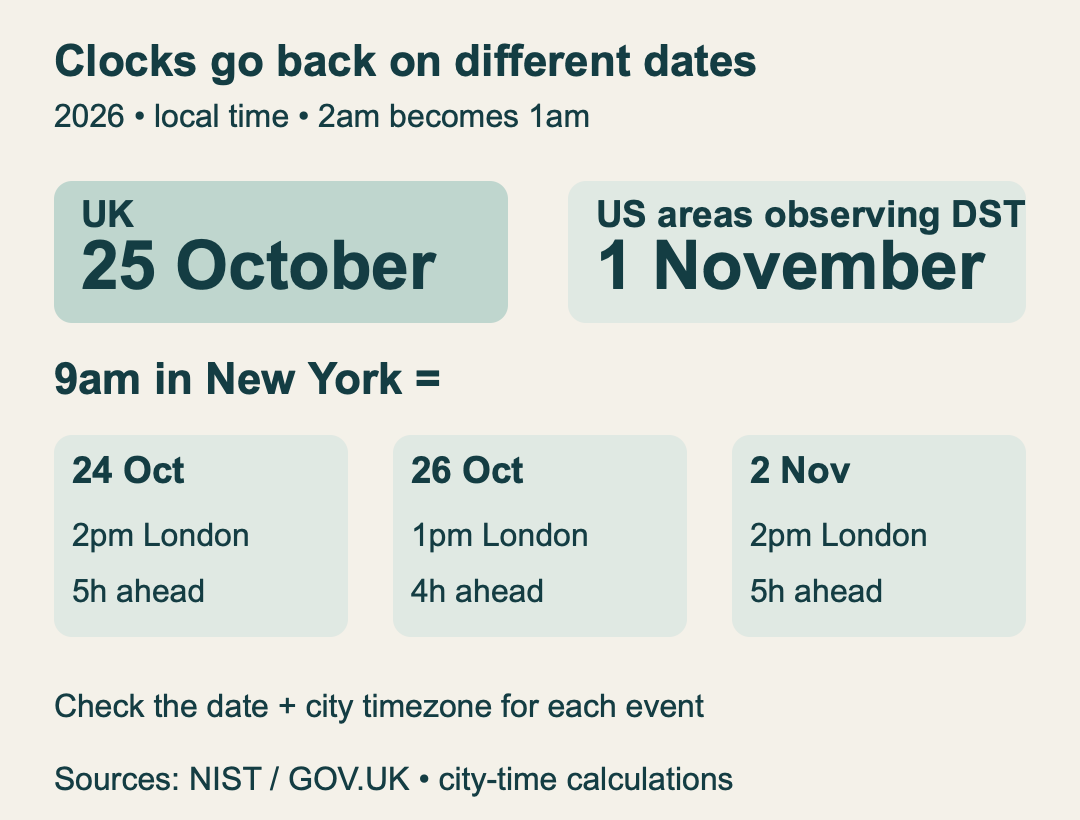
Daylight saving time ends in participating US areas at 2 a.m. local time on Sunday, November 1, 2026: clocks return to 1 a.m. Britain makes its change a week earlier, at 2 a.m. on Sunday, October 25. These are the dates currently published by NIST and GOV.UK, checked on October 7.
The dates matter amid renewed US debate over permanent daylight saving time. ABC News’s October 6 explainer connects that debate with this autumn’s clock change. For planning a journey or call, use the official schedule for the place and date involved; a proposal or a political headline is not a replacement for that schedule.
Two countries, two local changes
US rules end daylight saving time on the first Sunday of November; the UK changes on the last Sunday of October. At the autumn change, 2 a.m. becomes 1 a.m., repeating an hour. This moves daylight towards the morning by the clock; it does not create extra sunlight.
The change does not apply everywhere in the US. The Department of Transportation lists Hawaii, most of Arizona and several US territories as exceptions. NIST identifies the Navajo reservation as an exception within Arizona that does observe DST. Check the particular location rather than assuming a nationwide clock adjustment.
London is four hours ahead of New York for the intervening week
On October 24, a 9 a.m. New York appointment corresponds to 2 p.m. in London. On October 26, after Britain has changed but before New York has, it corresponds to 1 p.m. in London. On November 2, after both changes, it is back to 2 p.m. These are our date-specific timezone calculations, not three changes to the New York appointment itself.
The practical consequence is for recurring meetings and travel across countries. A fixed clock time in one city can shift in the other. Use the calendar’s named city timezone and inspect the event date, especially between October 25 and November 1; do not carry over a five-hour conversion from an earlier week.
Check devices and confirm ambiguous appointments
NIST explains that internet time services provide UTC; the computer’s operating system applies local timezone and DST corrections. Keep the operating system’s time settings and updates current. If a radio-controlled clock is wrong after the change, check its time-zone setting and whether it received its signal. Manually set clocks may require a separate adjustment.
For an appointment in the repeated 1 a.m. hour, ask the organiser to specify the timezone or UTC offset as well as the local time. For ordinary daytime calls, confirming the date and both city times is usually enough. The useful distinction is the official local change date and the resulting cross-border conversion, not a single worldwide “clocks go back” day.
Official sources were checked directly. Unannounced conditions, individual results and editorial calculations are distinguished in the article.
- NIST: Daylight Saving Time Rules ↗
- US DOT: Daylight Saving Time ↗
- GOV.UK: When do the clocks change? ↗
- ABC News: October 6 clock-change explainer ↗