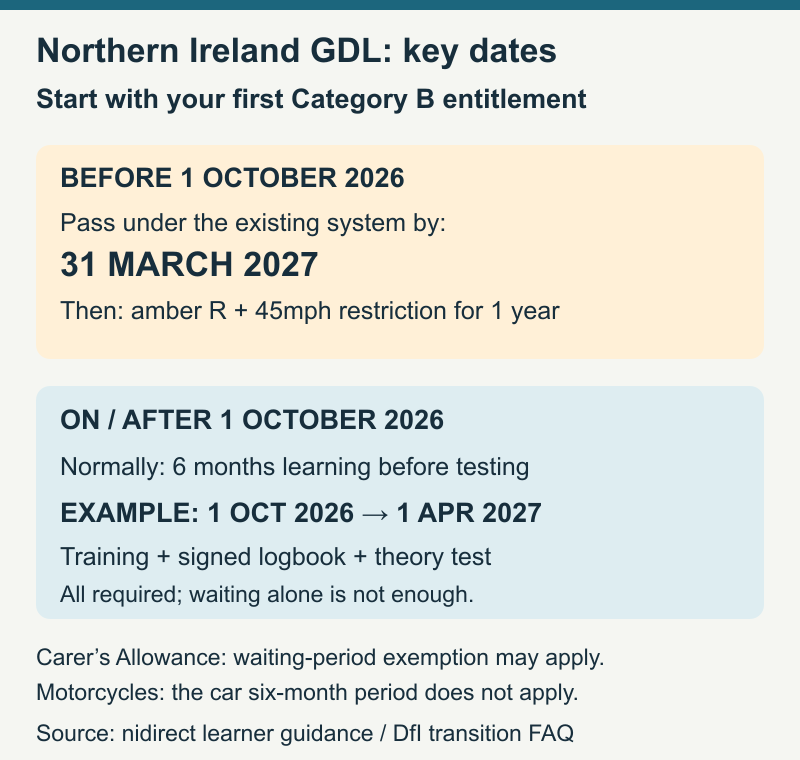
Northern Ireland’s GDL scheme applies to learners whose provisional entitlement began on or after 1 October 2026. Car learners normally need at least six months from their first Category B entitlement before testing. Those whose entitlement began earlier can pass under the existing system by 31 March 2027. This is not a UK-wide licence change.
The phrase “new driving licence rules” does not establish who is affected. This is a Northern Ireland scheme. Treating it as a simultaneous change to every UK driver’s licence risks obscuring the conditions that actually matter.
Which date matters for a car learner?
| Your situation | What to check |
|---|---|
| First provisional Category B entitlement on/after 1 Oct 2026 | Normally six months learning + training/logbook + theory test |
| Entitlement before 1 Oct 2026 | Pass under existing system by 31 March 2027 |
| Practical test from 1 April 2027 | GDL training/logbook completed before booking |
| Carer’s Allowance exemption | Six-month wait may be waived; training/logbook still required |
General official guidance, not an individual eligibility determination. Motorcycle learners are exempt from the car six-month period.
Passing a test and judging risk are different challenges
Northern Ireland’s government says 17-to-23-year-olds held 8% of driving licences in 2024 but were responsible for 24% of fatal or serious-injury collisions. Its concerns extend beyond vehicle handling to night driving, young passengers and limited experience in recognising and assessing hazards.
That points to learning which a single test cannot fully capture. GDL adds preparation time and controls on early driving conditions alongside education and enforcement. A policy’s purpose is not proof of its results, however: just after launch, there is no basis here to attribute a reduction in Northern Ireland’s collisions to the scheme.
The same month, but different routes to a licence
GDL applies when provisional entitlement begins on or after 1 October 2026. For car learners, a minimum six-month learning period normally follows that start date. Training must be completed and signed off in a logbook; the revised practical test begins on 1 April 2027.
Learners whose entitlement began before 1 October have a transition period to pass under the existing system by 31 March 2027. The relevant dates are therefore the start of entitlement and the actual test, not simply when a booking was made. The Department for Infrastructure FAQ distinguishes earlier entitlement holders who pass during that transition: they keep the amber R plate and 45 mph restriction for one year. From 1 April, all learners must complete GDL training and the logbook before booking the practical test.
Waiting is not enough. The car programme has 14 compulsory modules and an optional module, with progress recorded in a logbook. Access to the online or app-based GDL account costs £17. That is an account charge, not the full cost of getting a licence.
Protection with exceptions for everyday life
GDL drivers display R plates for two years. During the first six months after passing, car drivers under 24 may carry no more than one passenger aged 14–20 between 11 pm and 6 am. Immediate family are exempt, as are journeys with a front-seat passenger aged at least 21 who has held a full licence for at least three years. This is not a blanket ban on night driving.
Motorcycle learners are exempt from the car scheme’s six-month minimum. Learners who establish entitlement to Carer’s Allowance can also receive a minimum-period exemption, but must still complete the training and logbook.
Those exceptions illustrate the balance between preparation for safe driving and essential mobility. The practical burden will depend on people’s training and travel circumstances. The government’s suggested possibility of lower insurance premiums over time is likewise not a promise of immediate savings for every driver.
What happens after the threshold matters
The change asks more than that learners wait longer. It shifts attention from the moment of passing to experience gained on either side of it. Its success should be judged by safety and the burden on learners, rather than the number of new rules.
For someone preparing to drive, location, entitlement start date and test date are more useful than a broad headline about UK rule changes. Comparing those details with the official guidance below is the starting point for understanding their own route.
Official Northern Ireland government and Department for Infrastructure guidance rechecked on 4 October 2026. This article concerns Northern Ireland, not a UK-wide change.
- NI government: scheme launch ↗
- NI government: learner-driver requirements ↗
- NI government: newly qualified drivers ↗
- NI government: rationale and collision data ↗
- NI government: programme and logbook ↗
- Department for Infrastructure: GDL FAQs ↗