President Donald Trump’s October 19, 2026, executive order directs the US Department of Health and Human Services to establish a Women’s Health Division within an existing National Institutes of Health institute or centre within 90 days. It also creates a White House Women’s Health Task Force to coordinate federal work.
The announcement addresses research and care across women’s and girls’ lives, from childhood through pregnancy, menopause and ageing. The White House identifies gaps in knowledge and in turning research into treatment as the reason for the initiative. Those are the administration’s stated goals; the order itself does not demonstrate that health outcomes have already improved.
What the October 19 order directs
| Action | Responsible body | Condition or timing |
|---|---|---|
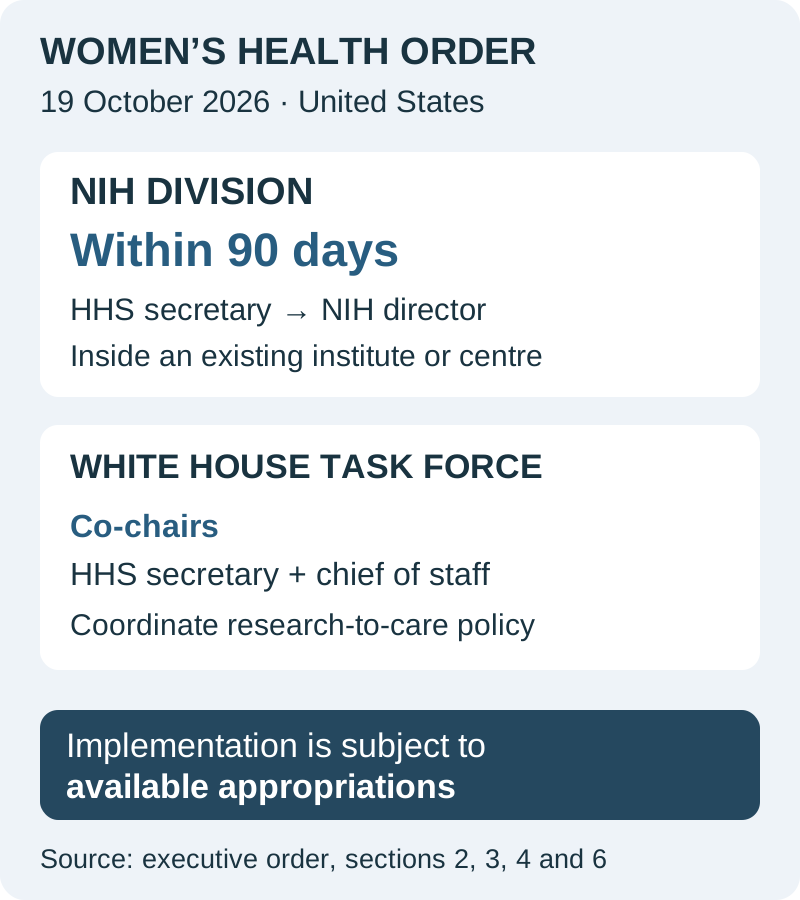
| Women’s Health Division | HHS through NIH | Within 90 days; inside existing institute/centre |
| White House task force | HHS secretary and chief of staff | Research-to-care policy coordination |
| Implementation | Relevant federal agencies | Subject to available appropriations |
The 90-day establishment deadline is not a deadline for every treatment outcome.
Two bodies with different jobs
Section 2 assigns the division’s establishment to the HHS secretary, acting through the NIH director. The new division must coordinate with NIH’s existing Office of Research on Women’s Health. Its specified work includes research methods, women’s and girls’ participation in clinical trials, and the use of sex as a biological variable in research.
The task force has a broader policy role. The HHS secretary and White House chief of staff will co-chair it, bringing relevant federal bodies into work on research, grant-making and the translation of findings into care. The 90-day deadline applies to establishing the NIH division; the order does not promise that every programme or treatment improvement will be delivered within that period.
A change in federal coordination
The order also revokes Executive Order 14120 of March 18, 2024, and the presidential memorandum of November 13, 2023, that established the previous White House women’s health initiative. The administration describes its new approach as extending the effort from research toward clinical care. The text still retains a coordination role for NIH’s existing women’s health office.
Delivery depends on later agency decisions and resources. Section 6 makes implementation subject to available appropriations, and the order does not specify a new dollar allocation. It also says it creates no legally enforceable right or benefit. Establishing the two bodies therefore does not by itself establish a new patient payment, insurance benefit or application scheme.
What patients and researchers can track
Researchers can use sections 2 and 4 of the linked order to distinguish the division’s research remit from the task force’s policy functions, then follow HHS and NIH notices for any specific funding opportunity. Patients seeking access to care will need the eligibility and service details of an actual programme; this announcement supplies no new application form. The agencies named are US federal bodies, and the order establishes no UK healthcare entitlement.
The next useful checks are whether NIH announces the division within the stated period, how it works with the existing office, and which funded programmes or clinical initiatives follow. Those observable steps will show how the October 19 commitments are being implemented. A later claim of improved outcomes would require evidence beyond the creation of an office or task force.
Based on the full October 19 executive order and accompanying White House fact sheet. This article explains the US policy text and does not offer clinical advice.
AI assisted with drafting and editing. This article is part of our preview edition. Editorial standards & corrections →