Astronomers have confirmed a triple star system roughly 28 light-years from Earth containing one red dwarf and two white dwarfs. The discovery of the inner white dwarf in Welopōʻai was reported in Astronomy & Astrophysics on 19 November. The farther white dwarf was already known.
An international team led by the Trottier Institute for Research on Exoplanets at the Université de Montréal found the star while looking for planets on Maunakea, Hawaiʻi. At around 27.6 light-years, the system shows how an overlooked stellar companion can turn up close to the Sun.
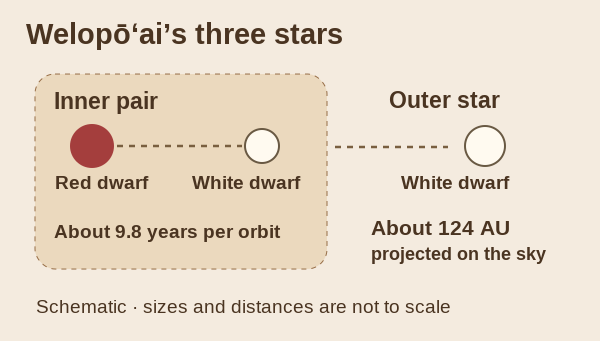
How a planet search found a white dwarf
Over about 4.8 years, the SPIRou spectrograph on the Canada–France–Hawaii Telescope measured the red dwarf’s line-of-sight velocity. The difference between the highest and lowest values was about 16 km/s. The paper concludes that a planetary companion cannot explain the measured signal.
High-resolution images from Gemini North then revealed the faint inner companion. Combining the velocity measurements with relative positions gave the white dwarf a mass of about 0.618 times the Sun’s, with an uncertainty of about 0.7%.
What 9.8 years and 124 AU measure
The red dwarf and the inner white dwarf orbit with a semimajor axis of 4.644 astronomical units and a period of roughly 9.8 years. One AU is approximately the average Earth–Sun distance.
The roughly 124 AU figure is the separation between the inner pair and the outer white dwarf on the plane of the sky. The inner orbital size and that projected separation describe different measures. The paper puts the outer period at more than 1,000 years, so the full orbit still needs more observations.
What readers can check in the paper
The abstract gives the system’s distance, period and stellar layout. Imaging and velocity data together pin down the inner pair, while the outer orbit remains less tightly constrained by the available measurements.
How the red dwarf ended up in its current orbit after its close companion expanded into a giant remains open. A better measure of the outer orbit would help researchers test whether gravitational interactions among the three stars contributed to their history.
Figures come from the author manuscript for Astronomy & Astrophysics, cross-checked with the university and institute accounts.
- Artigau et al. | Astronomy & Astrophysics author manuscript ↗
- Université de Montréal | Discovery announcement ↗
- Trottier Institute | Discovery notice ↗