Part of Brighton’s West Pier collapsed into the sea on Friday 23 October 2026 during Storm Austen, according to BBC footage and local reporting. The West Pier Trust’s standing advice is that the remaining structure is dangerous and should not be approached. The new collapse concerns a section of the ruin, rather than an announcement that the entire structure has disappeared.
The BBC footage shows one side giving way amid waves. Brighton and Hove News also reported a section falling that morning. Neither report provides a new engineering assessment identifying the precise failure mechanism. The immediate event sits within a much longer deterioration: the Trust describes the ruin as being in active collapse and says further losses are inevitable, although their timing cannot be predicted.
The event and the owner’s position
| Question | Verified answer |
|---|---|
| What happened on 23 October? | A section fell into the sea during Storm Austen. |
| Can visitors approach the ruin? | The Trust says the structure is dangerous: do not approach. |
| What was removed in 2010? | The concert hall remains; the pavilion frame was retained. |
| Is reconstruction scheduled? | No funded construction timetable established in the reviewed notices. |
The safety and management advice is the Trust’s standing policy, read on 23 October; it is not presented as a new statement issued after that morning’s collapse.
A pier closed long before the fires
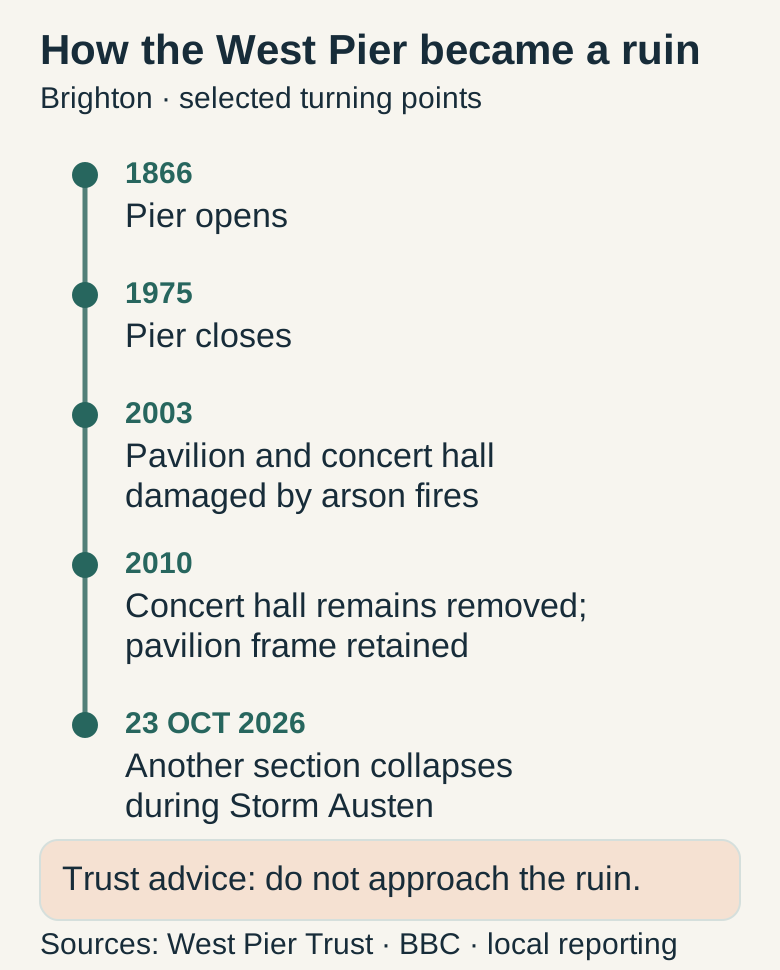
The West Pier opened in 1866 and closed in 1975. Its later silhouette was shaped by storm damage and two arson attacks in 2003. The Trust’s historical account dates the pavilion fire to 28 March and the concert hall fire to 11 May. Those fires are the reason the offshore remains should be understood as a ruin, not a visitor pier awaiting an ordinary reopening.
There were efforts to rebuild. The Trust records that an engineering assessment after the fires still considered restoration and reconstruction feasible using surviving material and archival evidence. That proposal did not become a restored pier: funding support was subsequently withdrawn. The historical assessment therefore describes an earlier scheme, not a current assurance that today’s frame can be repaired.
Why some remains were removed and others retained
In 2010 the concert hall remains were removed after they became a public hazard. The pavilion frame stayed. The Trust’s account says it will not remove that frame unless there is an overwhelming safety reason, and describes the present ruin as beyond repair. The two decisions concern different parts of the former pier; retaining the pavilion does not mean the owner regards it as safe to enter.
The Trust’s current management plan is to mark the site, warn people away and remove debris reaching the beach at low water. It says holding the ruin in a stable condition is technically unfeasible and beyond its funds. It also describes an ambition for a new contemporary West Pier. That ambition is distinct from rebuilding the existing frame, and the pages reviewed do not provide a funded construction timetable.
What the warning means for a visit
People visiting the seafront should follow the Trust’s instruction not to approach the structure, and any site markings or warnings. The fact that remains become more visible at low tide is not an invitation to walk out to them. For the pier’s history and exhibitions, the Trust directs visitors to the West Pier Centre in a beach-level arch east of Brighton i360; it notes that bad weather can cause temporary closure.
Friday’s loss changes the outline of a familiar landmark, but it does not by itself establish a new restoration plan or a safe route onto the remains. The useful next information is a dated update from the Trust about the condition of the site, debris management or access advice. Until that changes, its existing warning remains the practical guide: view the ruin without approaching it.
Based on dated original reporting and West Pier Trust documents read on 23 October 2026. The Trust’s standing advice is distinguished from today’s event.
- BBC: part of Brighton’s West Pier collapses, 23 October ↗
- West Pier Trust: Collapse and Fire ↗
- West Pier Trust: current ruin management and safety advice ↗
- Brighton and Hove News: 23 October collapse report ↗