RMT has announced a 24-hour London Underground driver strike starting at noon on Thursday, November 26, 2026, the first of eight walkouts extending into February 2027. The union’s November 6 announcement sets a noon start for every date. For a trip, that means the announced action also covers the following morning, rather than fitting into one midnight-to-midnight day.
The action concerns proposed working arrangements including a voluntary four-day week and a Trains Modernisation Framework. Three starts fall in November and December 2026 and five in January and February 2027. These are announced driver walkout windows; they are not a published timetable showing every Underground line closed throughout them.
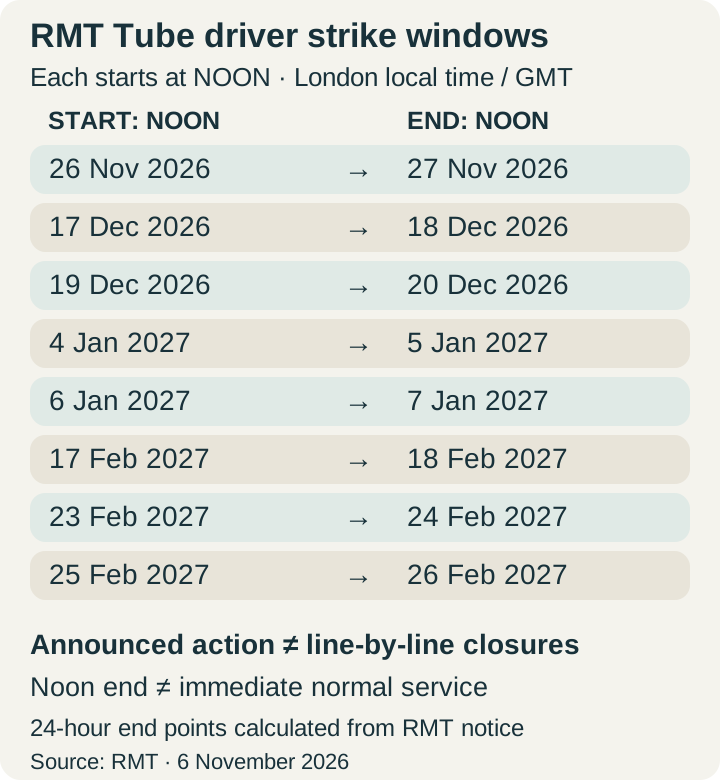
Eight starts also mean eight following-day end points
The 2026 windows are November 26 at noon to November 27 at noon, December 17 at noon to December 18 at noon, and December 19 at noon to December 20 at noon. Each end point follows directly from the announced 24-hour duration. All times here are London local time, which is GMT on these dates.
The 2027 windows are January 4–5, January 6–7, February 17–18, February 23–24 and February 25–26, each from noon on the first day until noon on the second. They are separate stoppages rather than a continuous strike across those months. A booked journey the morning after a start date can therefore still fall within an announced action window.
The dispute is about the conditions attached to a shorter week
RMT says the proposed framework would require more driving time, longer duties and less predictable shifts, and weaken protections even for drivers who keep a five-day week. It also alleges a risk of job cuts and displacement from existing depots. These are the union’s objections to the proposals, not established staffing losses that have already occurred.
TfL gives a different account. In the BBC report, it says the change is voluntary, means fewer working hours overall, and guarantees that drivers keeping a five-day week can remain at their depot. The BBC also reports that Aslef, which represents other drivers, questions the strike decision; the dispute therefore cannot be described as all drivers or all unions taking the same position.
Use the dated journey plan as well as the strike calendar
The TfL strikes page checked on November 7 displayed a suspended bus-action notice, rather than a line-by-line plan for these Tube dates. Travellers can use TfL’s Plan a journey page to enter the actual origin, destination and departure time, then check the linked service-status pages and any later dated strike advice. The existing bus notice does not withdraw the separate RMT announcement or establish which alternative services will be unaffected.
The calendar establishes when RMT says its members will stop work; the operating plan must establish how a particular journey can run. The noon end of industrial action does not itself promise an immediate return to normal service. Planning around both dates of each window, while using the operator’s dated advice when available, follows what is confirmed without turning the announcement into a blanket closure forecast.
Based on the original records and attributed reporting below. Dates, conditions and limits are retained.
- RMT:November6strike announcement ↗
- BBC:TfL and Aslef responses in the dispute ↗
- TfL:Strikes and service status ↗
- TfL:Plan a journey ↗