Navanethem “Navi” Pillay has won the 2026 Nobel Peace Prize. The Norwegian Nobel Committee announced the award on October 9, recognising her work to advance peace through international law. Its explanation centres on building institutions that can hold perpetrators of grave crimes accountable and give victims a route to justice.
The announcement concerns a career across several legal institutions, rather than a ruling issued today. Pillay’s background includes legal work against apartheid, service on international criminal courts and leadership of the UN human-rights office. The committee argues that peaceful resolution of disputes depends on an international legal order at a time when those institutions face pressure.
From legal practice to international institutions
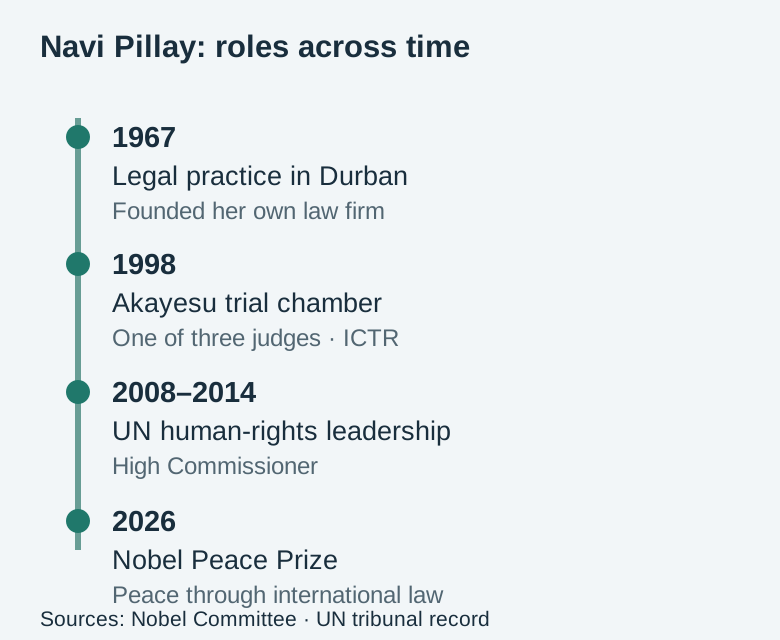
The official laureate profile traces her legal practice to a firm she founded in Durban in 1967. It records her term as UN High Commissioner for Human Rights from 2008 to 2014. These roles were different: representing clients, deciding cases and leading a human-rights institution are not interchangeable forms of authority.
A concrete example of her judicial work is the Akayesu case at the International Criminal Tribunal for Rwanda. The tribunal’s communication of September 2, 1998 lists three judges—Laïty Kama, Lennart Aspegren and Pillay—who unanimously convicted Jean-Paul Akayesu on nine counts and acquitted him on six. The decision should be attributed to that chamber, rather than described as Pillay’s ruling alone.
What the Akayesu case established—and what an award cannot decide
That communication explains a condition often lost in short biographies: sexual violence can constitute genocide when carried out with the specific intent to destroy a protected group. It does not say every act of sexual violence is automatically genocide. The linked UN page reports the judgment; it is an information release, not the full text of the court’s reasons.
The profile also identifies Pillay as an ad hoc judge in the ICJ case concerning Myanmar and as chair of the UN inquiry commission on the occupied Palestinian territory from 2021 to 2025. An ad hoc judicial role, a commission’s investigation and a Nobel award serve different purposes. The peace prize does not itself decide the merits of a case still before a court.
Read the citation alongside the legal record
To follow the announcement, begin with the committee’s dated press release, then use the laureate profile for the career chronology. For a specific legal claim, read the relevant court material and check who decided it, what conduct was assessed and which legal conditions applied. That approach avoids treating an award citation or a biography as a substitute for a judgment.
The useful question raised by the prize is how legal accountability can support peace, and where institutions still fail to deliver it. Readers can assess that argument by comparing the committee’s stated reasons with the scope of particular proceedings. Future corrections to the award information belong on this same URL; a later court decision would need its own evidence and date.
Official Nobel announcement/profile and the UN tribunal communication were read in full. The award rationale, the three-judge decision and its legal conditions are distinguished; the communication is not the full judgment.
- Norwegian Nobel Committee: 2026 announcement ↗
- Official 2026 laureate profile ↗
- UN ICTR communication on the Akayesu judgment, September 2,1998 ↗