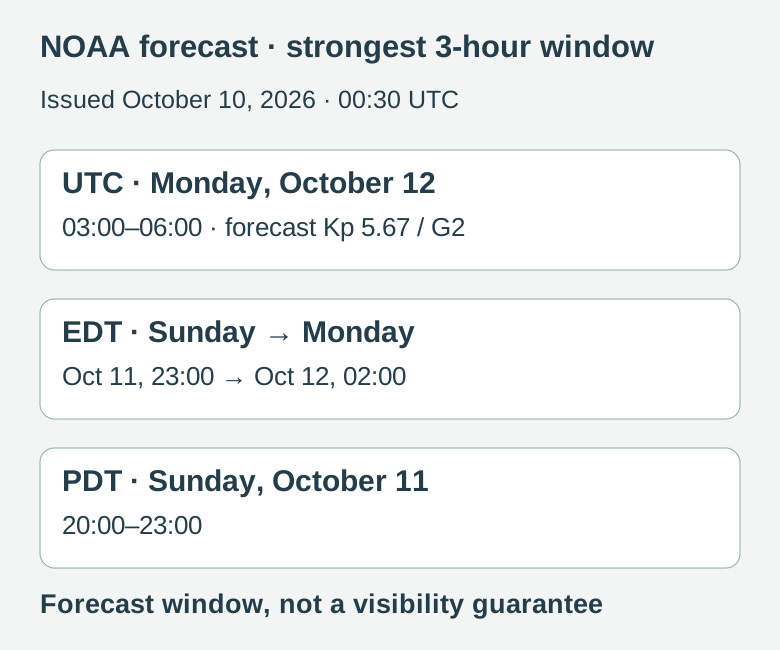
NOAA’s October 10 forecast puts G1 geomagnetic conditions late on October 10 and 11 UTC, with G2 possible early on October 12 UTC. For US viewers, the strongest forecast three-hour window is Sunday evening October 11 in Pacific time and late Sunday into Monday in Eastern time. This differs from an October 9 notice highlighting an October 11 G2 watch; neither statement guarantees northern lights at your location.
The distinction matters this weekend because search results mix dated storm notices, tonight headlines and live forecast products. The current three-day bulletin used here was issued at 00:30 UTC on October 10. NOAA’s aurora dashboard also labels October 10 and 11 G1, and October 12 G2. Read the forecast’s issue time and UTC date before planning an outing.
Read the dated watch and later forecast separately
The earlier notice, published October 9 at 19:45 UTC, describes two coronal mass ejections from October 7 and 8 and an expected interaction on their way to Earth. The later forecast discusses several CME arrivals and possible coronal-hole high-speed-stream influences. Those are NOAA’s stated physical drivers; this article does not infer that a specific watch was formally cancelled or explain an unpublished revision decision.
The bulletin’s maximum forecast interval is 03:00–06:00 UTC on October 12, Kp 5.67 and G2. That converts to October 11 at 23:00–October 12 at 02:00 EDT, or October 11 at 20:00–23:00 PDT. Adjacent intervals are forecast G1. These are forecast activity windows, not a reservation for a visible display; UTC October 12 does not mean waiting until Monday evening in the United States.
Activity is only one part of visibility
NOAA’s viewing guide separates geomagnetic activity, location, darkness and timing. Higher Kp can extend activity away from the poles, but the latitude relationship is approximate. A storm category alone does not provide a reliable list of cities where an observer will see aurora. Local cloud cover and an unobstructed northern horizon still matter.
For a practical check, open the official aurora dashboard and compare its tonight/tomorrow view line with your location, then use the short-term forecast near the time you intend to go out. Check a local National Weather Service forecast for cloud conditions. Choose a dark place with a northern view; NOAA’s general viewing guidance favours roughly 22:00–02:00 local time, but that guidance is not the same as this weekend’s predicted peak.
Check the current products before travelling
Keep three labels separate while checking: an observed storm describes measured conditions, a dated watch describes a forecast risk, and an aurora map estimates where viewing might be possible. A bright photograph from another state or a yesterday headline does not replace the latest official product. The source links below give the dated watch, the issued bulletin and the live dashboard so the comparison can be repeated.
The decision to travel should depend on both a current forecast and local viewing conditions. If NOAA changes the arrival timing or activity level, use the newer issue rather than preserving an old date from a headline. The useful follow-up is whether measured activity and the local sky support the plan; this forecast does not establish that a display has already happened.
NOAA’s dated watch, issued three-day bulletin, live dashboard and viewing guide were read directly. UTC dates are converted separately to EDT and PDT. A forecast window does not guarantee local visibility.
- NOAA aurora dashboard ↗
- NOAA October 9 datedwatch ↗
- NOAA issued 3-dayforecast ↗
- NOAA aurora viewing guidance ↗
- National Weather Service local forecast ↗