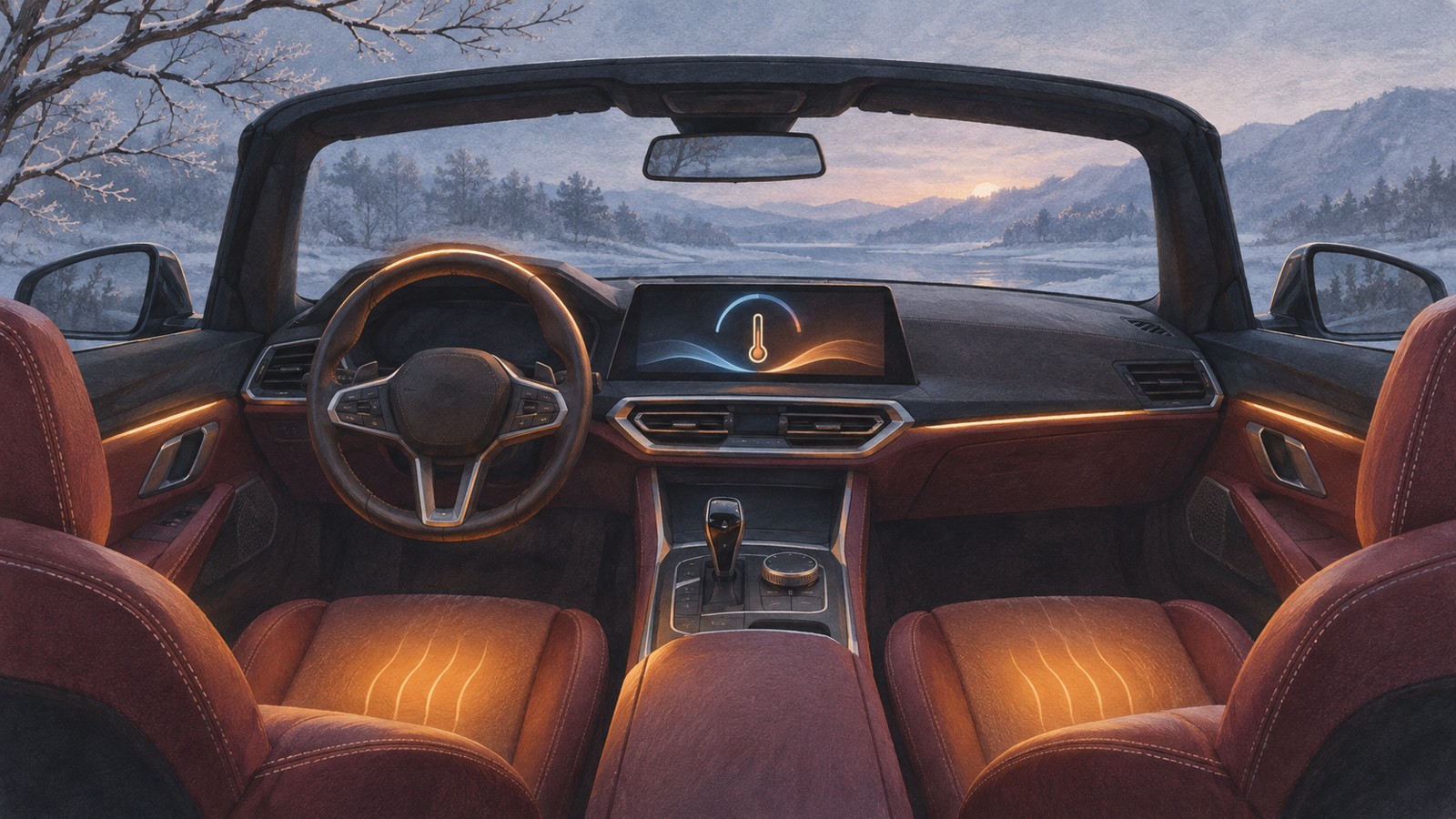
UPMI Lab changed HU_MGU and BDC coding on a BMW G29 to enable automatic steering-wheel and seat-heating settings. It read the settings back from the vehicle to confirm their application; automatic activation during an actual cold start still requires further testing.
The owner selects temperature thresholds and heating levels in the vehicle menu. The confirmed results extend to menu activation and coding read-back. This is not presented as verification of passenger-occupancy detection or operation under every cold-weather condition, nor as removal of a paid subscription.
Convenience depends on how settings fit everyday use
People can want the same heaters to activate at different times and intensities. Temperature, heating level and seat conditions separate the presence of a function from convenience when it is needed. Automation becomes useful when these conditions match the user’s routine.
Vehicle coding was performed separately from installing the Seats app. Driver- and passenger-seat-related settings were applied and read back, but temperatures mentioned in the initial discussion were not adopted as final thresholds. The owner was left to select actual values in the car. Personalization is not simply copying someone else’s settings.
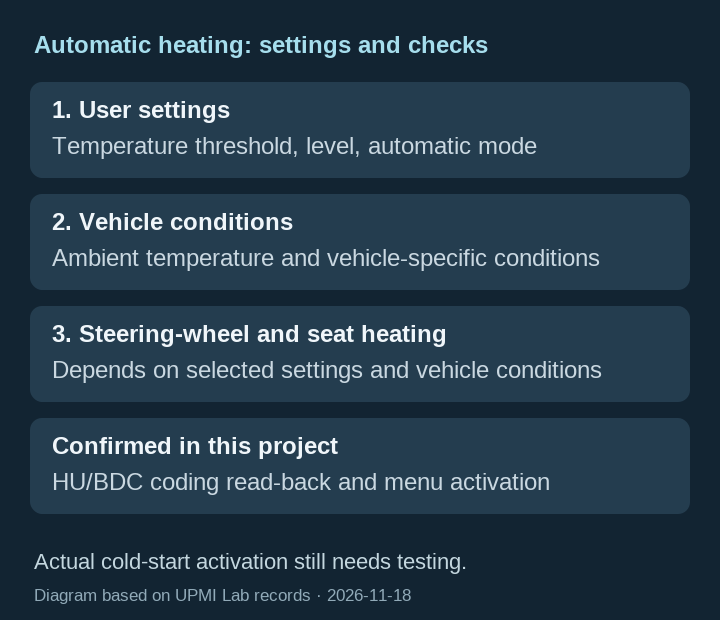
An enabled menu still requires testing in use
Once a menu is available, users can enter their preferences. The next step is to check whether the desired behavior occurs when ambient temperature, selected thresholds and seat conditions interact. Coding read-back and menu activation on this car do not verify passenger detection or automatic operation in all low-temperature conditions.
Follow-up testing should therefore record ambient temperature, selected threshold and level, seat conditions and behavior after starting. Whether the request becomes a practical convenience depends on those circumstances. The diagram explains the relationship between settings; it cannot prove operation that has not yet been filmed.
What enabling a feature does and does not establish
Enabling features through software shows that use can change after a car is purchased. It does not by itself establish a conclusion about the manufacturer’s sales policies. Evidence was not obtained for this car’s past service entitlements or a claim that automatic heating in all G-series cars was subscription-restricted. The work cannot therefore be described as unlocking a paid entitlement or subscription.
The relevant change is an owner exploring available settings and connecting them to everyday needs. The same settings may not suit vehicles with different equipment or software. Recording the conditions and outstanding tests makes one person’s experience useful for others’ decisions.
Users help define a car’s future functions
The ID7 series begins with requests from the same driving seat: closer navigation, seat movement suited to the user, direct access to vehicle status and fewer repeated actions in cold weather. Public tools and revisions translated everyday needs into specific screens and settings.
Automatic heating still has cold-weather testing ahead. Including that unfinished state, the project moves the user from consuming a feature toward specifying its conditions and evaluating results. Hardware durability is not the only contributor to keeping a car useful. Opportunities to adapt it to changing routines matter too, and this G29 project shows how an owner seeks them.
An in-house feature about work on the UPMI Lab operator’s personal car, checked against vehicle photographs and videos, the owner’s reports, retained handover records and public project documentation. The demonstrations were conducted while parked. This is not a BMW official product or support program, or an independent road test. Original interface captures and linked Lab records are in Korean.
- UPMI Lab · Original vehicle project record (Korean) ↗
- MGU Store · Installation requirements and app management ↗
- bimmer-lab · Cluster themes and driving modes ↗
- iDrive Custom Apps · Diagnostics app development ↗
- SSH tool · Pre-flash backups and coding restoration ↗